.svg "2Win logo25 white (1)")


 2Win!
2Win!
1 min read
Why We Train the Way We Train: The 2% Factor
The 2% Factor: Why the Margin Between Winning and Losing Is Smaller Than You Think Every January, revenue leaders write a check for their sales...
A full selling year is roughly 250 working days. Your annual sales kickoff takes three of them. That's a meaningful investment, and it's the window where most revenue organizations concentrate their single largest bet on behavior change.
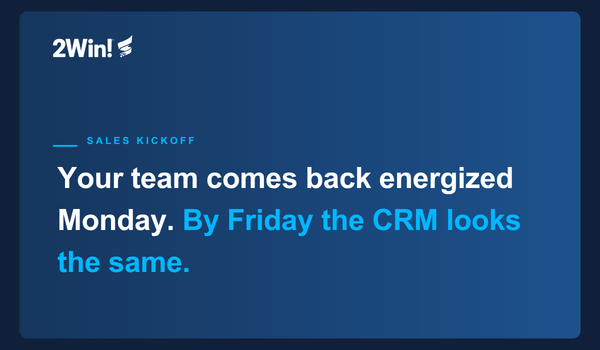
Here's the pattern most enablement leaders know well, because they've lived it. The team comes back energized on Monday. Sellers talk about the keynote, the new methodology framework, the workshop that finally named something top performers were already doing intuitively. By Friday, the CRM looks the same as it did the week before. Not because the team isn't trying. Because no one designed the bridge between the room and the deal.
That's a fixable problem.
Sales kickoff ROI depends on whether your event was designed to change behavior or simply deliver information. Most SKOs are built around information transfer: keynotes, roadmap updates, and breakout panels that produce alignment and morale but don't build skills. A skills-based SKO framework assesses execution gaps before the event, uses coached practice during the event, and sustains behavior change through structured 30/60/90-day reinforcement afterward. The organizations pulling ahead in 2026 are designing for all three.
Walk into any sales kickoff planning meeting, and the same agenda emerges: a CEO keynote, a product roadmap update, a partner panel, breakout sessions led by product marketing, a team dinner, and an awards ceremony for last year's top performers.
This agenda isn't irrational. It satisfies a real set of needs: alignment with company direction, visibility for executive leadership, a moment for culture-building, and morale. Those are legitimate outputs. The problem is that most organizations conflate them with behavior change, but they're categorically different.
A seller can sit through a product roadmap update and leave with accurate knowledge about what's shipping in Q3. That's useful. What they can't do is sit through a keynote and leave with a new discovery technique. Skills require something knowledge doesn't: practice, feedback, repetition, and enough psychological safety to be wrong before getting it right. The legacy SKO agenda creates none of those conditions.
The typical SKO agenda was built for alignment and morale. Both are real outputs. Neither one is behavior change.
The reason this model persists isn't that revenue leaders don't see the gap. Most of them do. The honest answer is that the alternative is harder to plan, harder to get executive buy-in for, and harder to defend when immediate post-event feedback shows sellers didn't love the format. A skills-based session where sellers run live discovery calls on real accounts in front of their peers feels riskier than a keynote. The safe choice stays safe.
The cost of that safety shows up in the metrics roughly 60 days after the closing dinner.
Three shifts have moved the legacy SKO from insufficient to actively counterproductive.
Every January, sales organizations pull their entire team off the field for two or three days. That investment used to make sense partly because SKO was the best vehicle for transferring product knowledge at scale. AI changed that math. When every rep has an assistant that can surface competitive positioning, feature details, and use cases on demand, the annual knowledge download isn't a reason to gather anymore. It's a commodity. What's still scarce is a seller who reads a room, asks questions that uncover real motivation, and connects the product to outcomes the buyer actually cares about. Those are judgment skills. They require practice, repetition, and live coaching. An SKO still built around product knowledge is spending its most expensive days on the thing that costs nothing the rest of the year.
Decision cycles are tighter than they were three years ago. The window where a seller can recover from a weak first impression is smaller. The cost of reverting to old habits after SKO has never been higher, because the margin for error in each individual opportunity has never been thinner.
If your kickoff runs a session that could be a pre-recorded module, you're spending conference venue money and your team's best attention on something they could absorb on their own schedule in a week. SKO time should be reserved for what async platforms can't do: coached, observed, corrected practice in a room full of peers.
These three shifts converging mean that "good enough" SKOs are losing ground faster than they used to. The organizations pulling ahead have accepted the real trade-off. Some things get cut from the agenda so that skill development gets the time and structure it actually requires.
Designing a sales kickoff for behavior change looks different at every stage of the process. At 2Win! Global, we use a four-stage engagement model: Assess, Train, Reinforce, Measure. It applies to every skills development engagement, including SKO. Most organizations execute Stage 2 (Train) and skip the other three entirely. The output is predictably limited.
Most SKO agendas are assembled without diagnostic data. Leaders make educated guesses about where the team is struggling (discovery, demos, executive engagement) and design sessions around those guesses. Some guesses are right. Many aren't.
Assessment before the event means running a structured analysis of where execution is actually breaking down. Specifically:
Where deals are stalling in the sales cycle, and why execution is breaking down at those points
Where the gap between top performers and the rest of the team is widest, skill by skill
Which specific behaviors need to change for win rate and deal velocity to move
That data shapes the agenda. Nothing runs because someone liked the speaker.
The difference between a skills-based session and a traditional breakout is visible from the back of the room.
Take executive engagement training at SKO as a concrete example. A traditional breakout on executive conversation technique involves a presenter, slides, and a few role-play vignettes that everyone watches, and sellers leave more informed than when they arrived. A skills-based session built around the Winning with Executives framework runs differently. Before the event, sellers are assigned a real executive stakeholder from their pipeline and asked to define a Current Position, a Desired Position, and the business impact that justifies moving between them. At SKO, they:
The session ends not with a slide deck but with sellers who have practiced under observation and been corrected on something real.
A skills-based SKO replaces low-value sessions with structured practice built around the selling work sellers already do every day. When methodology is coached against real pipeline and real deal scenarios, adoption accelerates quota attainment rather than competing with it.
A reinforcement plan is the most consistently skipped step in SKO planning. Teams spend months on the event itself and assume reinforcement will happen organically through manager coaching. It doesn't.
The post-SKO reinforcement plan should be finalized before the event opens, not drafted the week after it closes. For each milestone, there's a specific question that needs an answer before SKO starts:
At 30 days: What does each seller practice, and what does their manager observe and coach on?
At 60 days: What's the evidence that behavior has changed? Look for methodology adoption in actual calls before attributing it to the event.
At 90 days: What do the leading indicators say (methodology adoption rates, pipeline quality, deal velocity) before lagging indicators show up in win rate?
Sales kickoff planning that ends with the closing dinner is half a plan.
Most organizations can't prove sales kickoff ROI for a simple reason: they never defined what success looks like before the event ran. Post-event surveys measure satisfaction, not behavior change.
Sales kickoff measurement works when it's designed from the beginning. At 30 days, you track leading indicators: are sellers using the methodology in actual calls, is pipeline quality moving, are manager observations in deal reviews showing different behavior? At 90 and 180 days, you look at the lagging indicators: win rate movement, deal velocity, and expansion revenue. These aren't complicated numbers to track. They require an intentional decision to define them before the event, not a retrospective search for evidence after.
Enablement ROI is measurable. The gap lives in planning, not data.
One honest note on who owns the reinforcement layer: most enablement teams are at capacity before SKO planning begins. Adding a structured 90-day reinforcement program on top of an existing workload will compound the original design problem. The organizations sustaining behavior change after SKO solve this by building the right team around the mission. That sometimes means working with a methodology partner who owns reinforcement, including agentic coaching tools that embed skills practice into daily selling workflows as part of how the job gets done, rather than as an add-on. Enablement bandwidth doesn't scale by working harder. It scales by building right.
The best enablement executives aren't the ones who own everything. They're the ones who know what the mission requires and build accordingly.
Stop asking "what should we put on the sales kickoff agenda?"
The more useful question is "what do we need sellers doing differently 90 days from now?"
The answer to the second question designs the event. If your SKO planning starts with speakers and ends with a dinner venue, you're building a morale rally. The teams winning in 2027 are building teams who know how to win.

1 min read
The 2% Factor: Why the Margin Between Winning and Losing Is Smaller Than You Think Every January, revenue leaders write a check for their sales...
1 min read
What if your favorite TV characters spoke at your 2024 Sales Kickoff 2024 SKO is our take on SKOs with celebrity or other “star” speakers. Want to...
1 min read
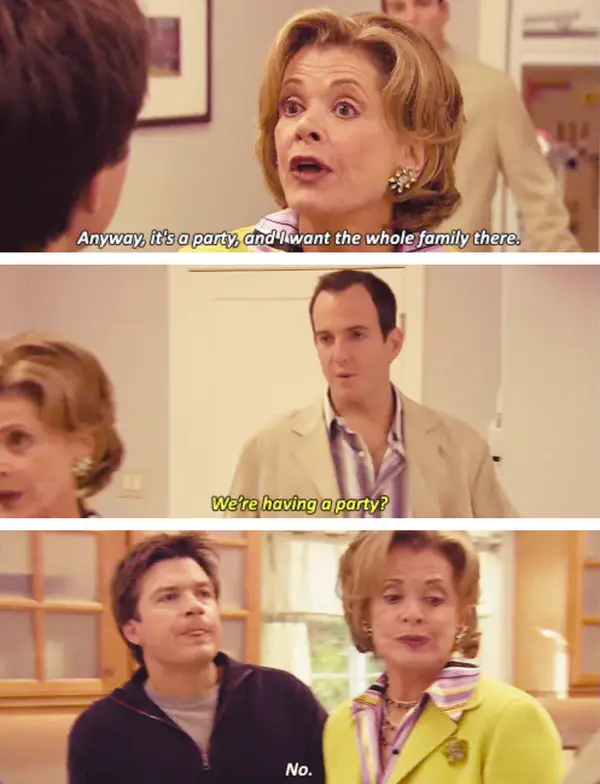
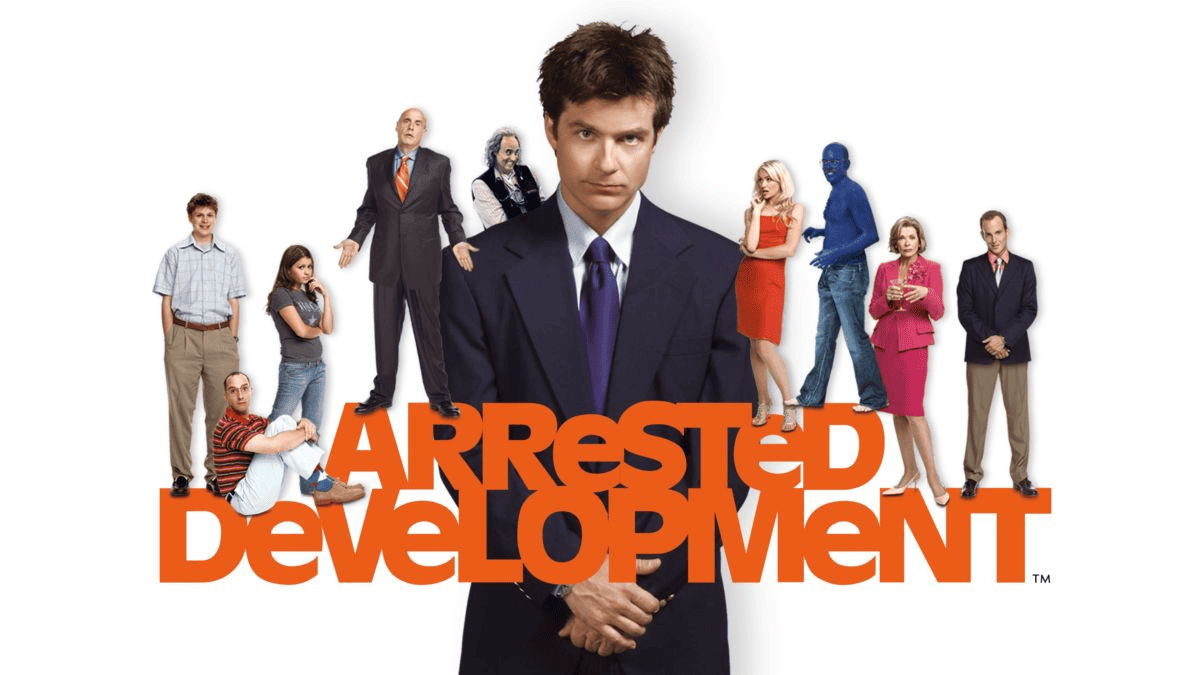
What if the Bluth Family from Arrested Development spoke at your 2024 SKO is our take on a potential SKO session featuring the dysfunctional Bluth...