



 2Win!
Did you know 2Win's methodology now lives inside the AI tools your team already uses?
Picture a senior SE at a mid-market software company who earned her Demo2Win! certification last spring and has built every demo since around the 2Win Structure. She has a Thursday demo for a VP of Operations and a finance director. So she opens her AI assistant, a general-purpose one with no 2Win methodology behind it, and asks for help preparing.
What comes back is a feature tour: eight capabilities in menu order, a welcome slide, and a pause for questions at the end. It reads confidently and sounds nothing like what she was taught. There's no opening built around what the VP of Operations cares about, no short list of topics tied to business impact, and no close that lands the value. She notices right away, because she remembers what the workshop taught and her assistant never learned it.
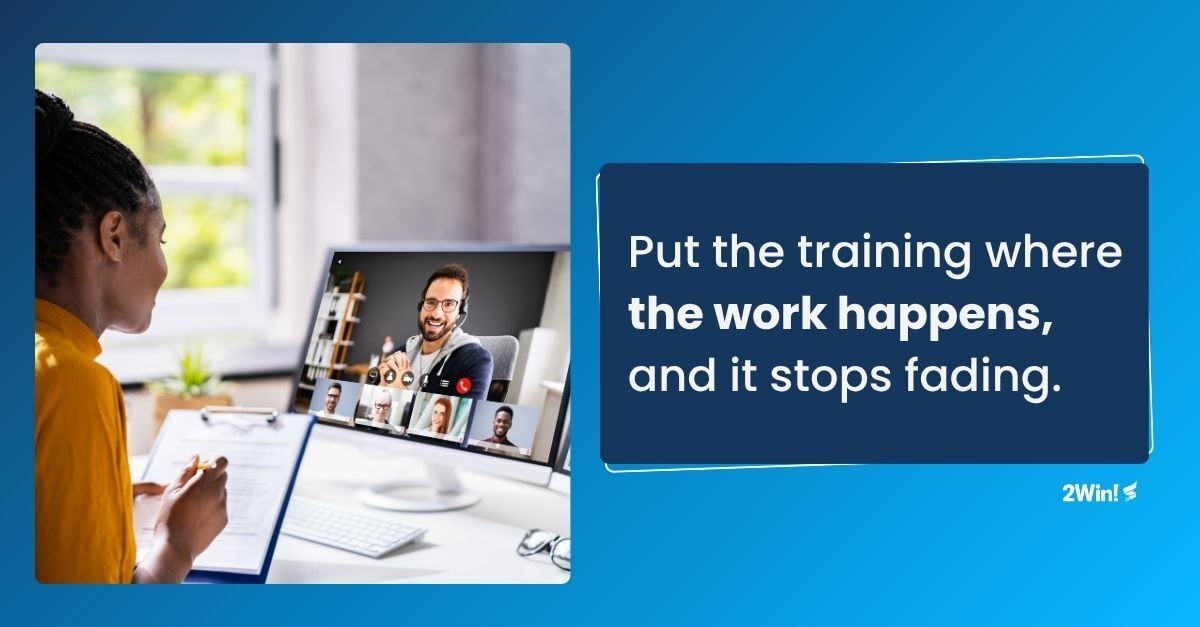
Sales training fades when the tools a team uses every day, such as templates, handoffs, and AI assistants, rarely reflect what the workshop taught. 2Win's Integration builds our methodology into those tools, so the judgment learned in training is present where the work happens.
headcount Freezes expose sales Effectiveness challenges as a revenue problem
The SE in the scene above did nothing wrong. She learned the method, but her assistant didn't. Multiply her by every SE on your team, and you get the long-documented pattern known as the forgetting curve: people lose much of what they learn unless something brings it back. A good workshop teaches the fundamentals, then the team returns to templates, handoffs, and AI assistants that look the same as before.
Your CEO or board is asking for more revenue from the team you already have. That pressure is real, but it isn't where the problem starts. You invested in training your people, and if the systems around them don't reinforce what they learned, that investment is less likely to pay off over time.
The training says one thing and the daily workflow says another.
Reinforcement does exist, and workbooks, coaching cadences, and roleplays all help. They're also the first things to slide when a manager has to choose between coaching and the deal in front of them. The deal wins. That's a reasonable call, but it means reinforcement that depends on a manager finding time to coach can't scale, and it shouldn't ask more of a team that's already stretched.
With headcount flat, the hours your team spends building a demo plan from scratch, or correcting a generic AI draft, come straight out of time with buyers. That turns a quiet problem into the central revenue question: how do you make sure what your SEs learned in presales demo training still shapes their work a year from now, without enablement and frontline managers carrying it person by person?
The first place it shows up is the AI tool your SEs already open every day. Most teams are answering the question with AI, but the answers depend on who built them.
Homemade AI workflows fill the gap, and results depend on who built them
Your team is already preparing with AI, and Salesforce's 2026 State of Sales report found that 87% of sales organizations use some form of it. Some of your SEs have built their own skills or prompts for it, and a few may have even built their own Demo2Win! skills. That's a good instinct, but the open question is what those tools are built from.
Without a shared system, every SE who builds their own AI assistant ends up with their own definition of a good demo.
Today's AI models already know about 2Win's methods, because much of the material is public. Ask one about Tell-Show-Tell, and you'll get a satisfactory answer. Speaking a language fluently takes more than vocabulary, though. A model working from public material uses the words and then uses them incorrectly, because it can't reason through the structure underneath.
That's why building only on public material doesn't produce a reliable partner. It's like handing an intern a few blog posts on Tell-Show-Tell and asking them to build every demo you give. They can recite the steps, but they can't tell which one the room needs next. That judgment comes from coaching and training, and it's what we've built directly into the plugin.
An AI tool without consistent and fluent methodology behind it can’t tell a good demo plan from a bad one.
What happens when two SEs each build their own
Here is a hypothetical: two SEs on the same team, with no shared integration, each build their own prep prompt. For the same kind of deal, one gets a plan with three topics tied to business impact and the other gets a twelve-step agenda in product-menu order. Their manager reviews both and can't say which is the standard, because nothing on the team defines one.
Multiply that by fifteen SEs, and you have fifteen assistants. Without a clearly communicated system, the drift is quiet: quality erodes a little at a time, and nobody can say when it started.
What integration looks like inside the tools your team already opens every day
Integration puts 2Win's methodology inside the AI tools your team already uses, so daily output reflects what people learned instead of a general model's best guess. There's no new meeting to schedule and no new product to learn. To see what that looks like, start with the standard the manager in our hypothetical couldn't name.
Four questions that hold any demo plan to the 2Win Structure
We'll use Demo2Win! as the example here. Its plugin lives inside the customer's own system and applies the workshop's SE coaching methodology to everyday tasks. Whether a person or an AI wrote the plan, these four questions show whether it follows the 2Win Structure:
- Does it prioritize customer outcomes? The limit forces discipline. You show only the topics that matter to this buyer, each tied to a specific business impact they care about, and everything else stays out of the demo.
- Does it start with a Limbic Opening? The first minutes frame the conversation around the impact your solution will have on the buyer’s department, before anyone sees the product.
- Is every topic told in Tell-Show-Tell? The Opening Tell gives context for the operational impact the topic will have, the Show proves it on screen, and the Closing Tell names that impact once the buyer has seen it.
- Does it end with a Value Close? The finish lifts what the buyer saw to the value it brings their department and backs it with proof, instead of asking “any questions?”
Hold the two plans from our hypothetical against those questions, and the manager has an answer based on demo structure best practices instead of personal preference. The twelve-step agenda in menu order fails the first question immediately.
What one Tell-Show-Tell topic looks like
Take an approval-routing topic for the VP of Operations in our opening scene. Here is how it sounds when it's built correctly, as an illustration:
- Opening Tell. Next is approvals. What you’re about to see is how approvals can move on their own at month-end, so your close isn’t held up waiting on a manager.
- Show. "Here's the queue. Each request arrives with its context attached, so approvers can decide in one click." The Show walks the screens and sprinkles in one benefit as it goes.
- Closing Tell. "So you saw approvals route themselves without waiting for a manager’s response." The impact is a faster close, because no one is waiting on approval at month-end.
How the integration carries both into daily work
Now go back to the SE with the Thursday demo. Same request, same VP of Operations. This time her assistant has the methodology behind it, so the plan comes back built in the 2Win Structure instead of a menu tour. Three everyday jobs change:
- Prep. The assistant builds a demo plan with three to five topics tied to business impacts and a visual roadmap for the room. It can also check a plan the SE already wrote against the structure.
- Scripting. Each topic is written in Tell-Show-Tell, and the whole demo is framed by a Limbic Opening and a Value Close.
- Handoff. Discovery notes from sales become demo-ready intake: what matters, what's still unknown, and what to ask next.
Nobody on your team should need to know an AI’s weak spots to trust its demo plan.
The training builds the judgment, and the integration puts that judgment within reach while the work is happening. The AI reinforces what your team knows and doesn't replace it. People can still shape the output for their own use case while the methodology underneath stays consistent. None of this is something your team builds alone: the integration is built with 2Win, not handed over as one more thing for a stretched team to figure out.
Four steps from a baseline to a standard that holds a year later
Reinforce + Grow, the third step below, is the part you just saw: the methodology working inside the tools your team already uses. It holds up because of what’s set up around it. The integration runs as one sequence of four steps, and each one has something your team can see and do:
- Assess. We look at real deal moments instead of running a generic maturity survey. Then we set a baseline on numbers like win rate, sales velocity, time-in-stage, and technical win rate, and we define what success looks like together.
- Train + Implement. This is the workshop. Your team practices on their own deals and earns certification, and it stays the foundation everything else builds on.
- Reinforce + Grow. The methodology gets built into the AI tools your team already uses, so daily output reflects what they learned. It happens while the work happens, not as another meeting or roleplay.
- Measure. A recurring quarterly business review is a working session, not a status update. It revisits the success you defined in Assess and reads integration data against what you're seeing in the business.
The cadence repeats as the team changes, backfills, and grows, so nobody is left guessing whether the standard is holding six or eighteen months out. A year later, the same team performs at a higher level, because the training hasn't faded and lives in the tools they use every day.
For teams where demo prep runs five to six hours per deal, our target is to move much of that time into practice, collaboration, sharper positioning, and more time with clients. That's a target, not a guarantee, and Assess is how we find out what's realistic for your team.
See the methodology inside your own AI tool
If your team has already trained with 2Win, start with the same question: what does integration look like for the program they completed? And if you need one line to bring to your CEO, try this: "We're not adding meetings or headcount; we're putting what our team learned inside the tools they already work in."
Ask what your training would look like if it were present in the tools your team opens every morning.