1 min read
Current and Desired Aren't Discovery.
They're the Setup.
The call went well by every measure an AE learns to track. The prospect, a Director of Revenue Operations at a mid-market SaaS company, walked through her current forecasting process in detail: the spreadsheet exports, the Friday scramble, the pipeline number nobody fully trusts. She described what she wanted instead, clearly enough that the rep could have drafted the requirements doc on the spot.
The questions were open-ended, the notes were worth reading twice, and the call wrapped two minutes early with a demo already on the calendar. Everyone left feeling good about how it went.
Three weeks later, the deal went quiet, not lost exactly, just quiet in the way stalled deals go quiet, and nobody on the team could point to what was missed because on paper nothing was.
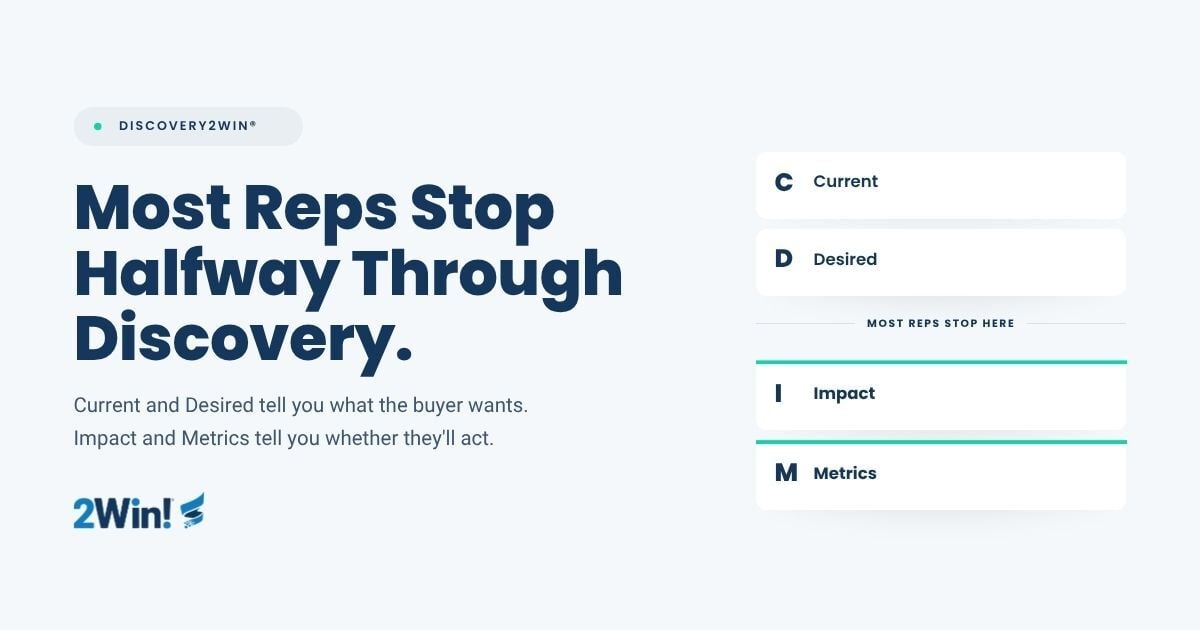
Discovery calls tend to stop at Current and Desired: what the buyer has and what they want. CDIM is a way to run discovery as a genuine conversation, but it only does that job when Impact and Metrics enter: why the change matters and how success gets measured. Skipping them turns discovery into a requirements form.
The discovery call that stops halfway
There's almost nothing in that call a manager would coach against. The Current questions were specific and well sequenced, the Desired questions surfaced a clear picture of where the buyer wanted to land, and if you scored the conversation against the first half of the CDIM framework (Current, Desired, Impact, Metrics), it would grade out near the top of the team.
The trouble is what didn't happen. Impact surfaced once, as a sympathetic nod on the way to the next question, and Metrics never came up at all. So the rep walked away with a well-documented picture of the buyer's current state and her desired state, the two things the first half of the framework is built to capture, and no sense of what the gap between them is costing her, her team, or her standing with the CFO who reads that forecast every Monday.
None of this is unusual, and that's the uncomfortable part. Watch a week of recorded discovery calls at almost any B2B software company, and you'll see the same pattern repeat: sharp Current, clear Desired, then a pivot to scheduling the demo. The call feels complete because the buyer's request has been captured, but a captured request only tells you what the buyer wants, nothing about why they'd act on it. And that missing why is the difference between a conversation that fills a CRM field and one that reveals a decision in progress.
Why Impact and Metrics get skipped, not just glossed over
Current and Desired questions are safe, and that safety is doing more work than it gets credit for. "Walk me through how you handle this today" asks the buyer to describe a process they live in every day, while "what would you want instead" invites them to talk about a future they'd enjoy having.
Neither question risks the relationship, and neither one risks silence.
Impact and Metrics work in different territory. Asking "what happens if this stays the way it is for another year?" invites a buyer to sit with what the problem is costing them:
- The missed number, and the forecast conversation that follows it, quarter after quarter.
- The analysts burning weekends on manual reconciliation while the work that actually moves the business waits.
- The credibility that erodes a little more each time the fix slips to next quarter.
A question like that can produce a long pause, and a pause feels dangerous on a call you're trying to keep comfortable, the same way the question itself can feel invasive, like you're prodding at something the buyer never offered to discuss.
Which is why the second half of the framework doesn't get under-executed so much as skipped entirely. Reps know CDIM, and most could phrase an impact question in their sleep. The sticking point is that the first half of the framework asks the buyer for a description, while the second half asks them for something much closer to honesty. Avoiding that discomfort is an understandable instinct, and it is the exact moment discovery quietly turns into intake.
Skipping Impact and Metrics doesn't shorten discovery. It just means you never actually did it.
CDIM's second half is what makes True Connection
The first half of CDIM produces information, and information is the easy part. Buyers run most of their evaluation on their own before a rep ever joins a call, and they've usually given the same current-state rundown to two other vendors in nearly the same words. Any competent rep, and increasingly any AI notetaker, can capture a current state and a wishlist. None of it tells the buyer you understood them.
What the second half of CDIM produces doesn't show up in a transcript. Asking about Impact means listening to what a problem is costing a person, in their business and sometimes in their career, and then reflecting back what you heard clearly enough that they feel understood rather than processed. Asking about Metrics means taking the buyer's success seriously enough to pin down how they'll know they got it, in their terms rather than yours. Both moves require the rep to stop working through a question list and start paying attention to the human on the other side of the call, which is exactly why they change how the whole conversation feels.
Current and Desired make you informed. Impact and Metrics build human connection.
CDIM is often talked about as if it were discovery itself, but it isn't. Discovery is the conversation: the thirty minutes where a buyer either opens up about what's driving them or politely recites requirements. CDIM is a way to run that conversation so it stays human:
- Current and Desired establish what's true today and what the buyer wants instead. That's the setup, and it's necessary, procedural, and safe.
- Impact uncovers why the gap between the current state and the desired one matters enough to act on, in the buyer's own words rather than your assumptions.
- Metrics pin down how both of you will know the change worked, on terms the buyer chose.
That's why stopping halfway is worse than running the whole thing clumsily. A rep who stops at Desired hasn't run a shorter version of discovery; they've collected the what and left the why, the part that determines whether anyone acts, sitting untouched on the table.
What finishing the framework actually sounds like
Picture the same moment landing on two different calls. A VP of Customer Operations lays it out plainly: "If this renewal cycle goes like the last one, I'm walking into the Q3 board meeting explaining churn I said we'd fixed. At that point it stops being a systems problem and starts being a me problem."
The first rep pauses and stays in that moment instead of moving past it. "You said it becomes a you problem. If nothing changes by Q3, what does that actually look like for you and your team?" The buyer talks for four minutes, and the rep paraphrases it back: the exposed renewal book, the reorg rumor that follows a missed number, the credibility being spent each time the fix slips. Then one more question: "If we get this right, what number would you want to put in front of that board instead?" Now there's a metric attached to a stake the buyer named themselves, in words the rep could never have invented.
The second rep hears the same sentence and responds, "Thanks for sharing that. How many seats are we talking about for the rollout?" Nothing rude happened; the buyer stayed polite for the remaining twenty minutes, and the notes will look thorough in the CRM. But the one moment where the buyer opened the door to why the deal matters got acknowledged and gently closed, and the conversation went back to collecting requirements with good manners.
Same framework, same buyer, same sentence, two completely different outcomes. What separates them is not a script or a technique, but the decision to treat Impact as the reason for the conversation rather than as a box already checked. The first rep walked away with the why behind the what; the second walked away with more of the what.
Half a framework builds half a Win Plan
Everything downstream of discovery inherits its depth. A Win Plan built only on Current and Desired can describe what the buyer wants, which means the demo will show the right features and the proposal will name the right requirements, and all of it will read fine while sounding like every competitor who heard the same wishlist.
A Win Plan built on full CDIM carries something the other vendors can't: the buyer's own words on what staying put costs them, and the number they intend to use to judge success. That's what elevates a demo from a feature tour into an argument for change, and it's what a champion repeats internally when you're not in the room to make the case yourself. Nobody fights for a project because the requirements matched; they fight for it because someone finally put words to what doing nothing costs, and they'd like that fixed before Q3 arrives.
A Win Plan built on half a framework only knows what the buyer wants, not why it matters.
So here's the shift worth making on your next call. When the conversation feels finished right after Current and Desired, treat that feeling as the signal to keep going rather than wrap up: ask what happens if nothing changes, and then let the silence sit until you get a real answer. The pause you're tempted to fill is usually the moment discovery actually starts.
Get the CDIM Guide
1 min read
Top Discovery Tips of 2025: Why There's No Excuse for Poor Discovery Anymore
The principles of discovery haven’t changed. But everything around it has.
1 min read
Applying Discovery
There are three steps to Applying Discovery: What did we learn in CDIM? The processing part is internalizing what we've heard to determine a...