Skip to the main content.
Book a Meeting Online Learning

5 min read

The Discovery Skill You Can't Script: Why 2Win Coaches Teach Empathy Before Technique

The Discovery Skill You Can't Script: Why 2Win Coaches Teach Empathy Before Technique

Dana was getting feedback from a 2Win coach on a recent call she was proud of. The questions were open-ended, the notes were clean, and the call ended with a demo on the calendar. By every visible measure, it was a good discovery call.

Her coach rewound to one spot and let it play. A moment where the buyer, a Director of Support drowning in ticket volume, mentioned almost in passing that she'd talked her own leadership out of hiring more agents, betting instead that better tooling would fix the backlog. On the recording, Dana heard the line, nodded, and moved to her next question.

"Right there," the coach said. "What did you do with that?"

Dana didn't have an answer. At the time it hadn't registered as anything, just one more comment in a call that was going well. But that was the buyer telling her what the decision actually meant, and it was the moment that explained why a good call had, three weeks later, gone completely still.

Running CDIM end to end is what turns a good conversation into a decision. It works because empathy is built into the framework, not layered on top: the questions only do their job when the rep feels what the buyer's answers mean, not just records them. That read on the buyer is a coachable craft.

The call that followed the playbook and still missed the person

Nothing in Dana's call would trigger a conversation with a manager. Her questions were open-ended, her sequencing was sound, and she got the buyer talking. Held to the standard most reps are held to, she'd done the job.

Which is the whole problem. The miss wasn't a bad question. It was a layer of the conversation that never happened, the one where a buyer stops describing a situation and starts telling you what it costs her to live in it.

That's what the buyer had started to do. The line about arguing against new headcount was a door. Behind it was the real stake: if this went wrong, it wasn't a process that had failed; it was her judgment, in front of the leaders she'd talked out of the safer option. Dana heard the words. Because nothing in her plan told her to slow down there, she kept moving.

The questions Dana asked were all fine. The one that would have shown her why the buyer cared never got asked.

This is what 2Win coaches spend their time on, and it isn't a better question list. It's whether a rep goes to the place where the decision actually lives, and whether they'd even recognize the door when a buyer opens it.

Why running the framework isn't the same as using it well

There's a difference between qualification and discovery, and a smooth call can hide it. Qualification sorts: is this a fit, is there budget, is there a timeline. Discovery finds out what actually drives the buyer to act. Dana did qualification and called it discovery.

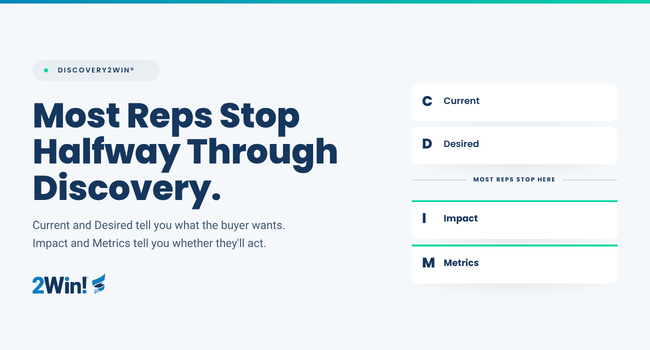
CDIM is how you make sure you aren't just qualifying. Current, Desired, Impact, Metrics takes a call past where the buyer is and where she wants to be, into why the gap matters enough to act on and how she'll know it worked. That back half is where a wishlist becomes a reason to buy, and it's the half Dana never reached.

But finishing the framework isn't a matter of asking two more questions. The Impact step isn't a data field. Asking a buyer what a problem is really costing her, and meaning it, invites her to say something that costs a little to admit, and you can't run that off a list. It only works if you take in the answer and let it change where you go next. Empathy isn't decoration on CDIM. The Impact step doesn't function without it, which is why even the most rational-looking decision has emotion underneath it.

Cognitive and affective: the two kinds of empathy, and the one reps skip

Discovery2Win teaches something called the Empathy Profile, and its most useful move is splitting empathy into two skills instead of one trait you either have or don't.

Cognitive empathy is your ability to see and understand what another person is feeling. You read the cues, you clock the shift in tone, you can name what's going on for them. Affective empathy is how much you let that register, enough that it moves you to do something different.

Dana had the cognitive half. When she played the recording, she spotted the buyer's stake in a second. The gap was affective. On the live call, letting the weight of what the buyer said change her next move was the harder skill, and it's the one that gets skipped, because acting on it means slowing down even when your plan says keep going. That's the part of the Impact step that turns a buyer's answer into a champion's motivation.

Cognitive empathy notices the buyer cares. Affective empathy is what makes you do something because of it.

You can watch the difference in a single coaching exercise. Ask a rep to summarize a call, and the first pass sounds like this: I understood their requirements; they want faster resolution and a cleaner queue.

Accurate, and flat.

Then make them sit with what they actually heard, and it comes back different: I understood that she staked her own credibility on this, and if it fails she's the one who looks wrong in front of the people she convinced.

Same call, same buyer. The second version tells you how to win it.

What it looks like when a coach changes the approach

None of this is about hunting for a naturally gifted rep. Take an SE named Marcus, strong on technical discovery and proud of it. Marcus didn't stop at the surface like Dana. He ran every step, stacked current on desired on impact, and built a tight logical case, all of it aimed at the system and none of it at the person across from him. His main contact, an operations lead at a growing logistics company, gave polite answers and nothing more.

His coach's note wasn't ask more questions. Marcus was asking plenty. Early on, the ops lead had said the last tool they rolled out was one more thing an already-stretched team had to absorb, and half of them quietly went back to the old way. Marcus filed it as an adoption risk and kept building his case. What he never heard was the worry underneath it: is this going to be one more burden on people who are already underwater?

The coach didn't give him a new script. The change was smaller and harder. When the buyer says something that costs her to say, stop and answer the person before you answer as an engineer. On the next call, instead of routing around the comment, Marcus named it: it sounds like the last rollout landed hard on your team, and you're not eager to put them through that again.

The ops lead loosened and started telling him what would actually make this safe to bring to her people.

That contact became his champion, not because Marcus uncovered new requirements, but because he finally ran the Impact step as a conversation instead of a data pull. This is why post-workshop reinforcement is important. 

You can't script it, but you can build it

The tempting read is that Marcus and Dana are just wired differently, that some reps have this and some don't. That's the belief that lets a team off the hook for building it.

The Empathy Profile is blunt about it: there's no right or wrong profile, it just is. A rep who feels less intensely isn't shut out of great discovery. She learns to watch for the moments that carry weight and respond to them on purpose, the same way a rep who feels everything learns to stay steady under a hard objection. Both are coachable, both improve with reps and reinforcement, and the place they practice is CDIM, because the framework gives the empathy somewhere to go.

That's why 2Win teaches empathy alongside technique, and it's both a culture choice and training choice. Any team can memorize CDIM's four steps in a week. Few build the discipline to treat the read on the buyer as a craft: something coached over time, reinforced after the workshop, modeled by the people who lead. That's what turns a room of reps who can recite CDIM into practitioners buyers actually trust.

So before your next call, ask two things, not one. Am I going to run CDIM all the way through, past the safe half? And when the buyer tells me what the change is really worth to her, am I going to feel it and follow it, or file it and move on?

Conversations, Not Interrogations: The Discovery2Win! Coaching Philosophy

1 min read

Conversations, Not Interrogations: The Discovery2Win! Coaching Philosophy

Current and Desired Aren't Discovery. They're the Setup. The call went well by every measure an AE learns to track. The prospect, a Director of...

Read More
Overcoming Presales and Sales Imposter Syndrome

1 min read

Overcoming Presales and Sales Imposter Syndrome

Imposter Syndrome is a psychological phenomenon in which people doubt their success or competence. This syndrome and how it impedes progress or...

Read More