.svg "2Win logo25 white (1)")


 2Win!
2Win!
The Rules of Executive Selling Have Changed. Here's What Wins
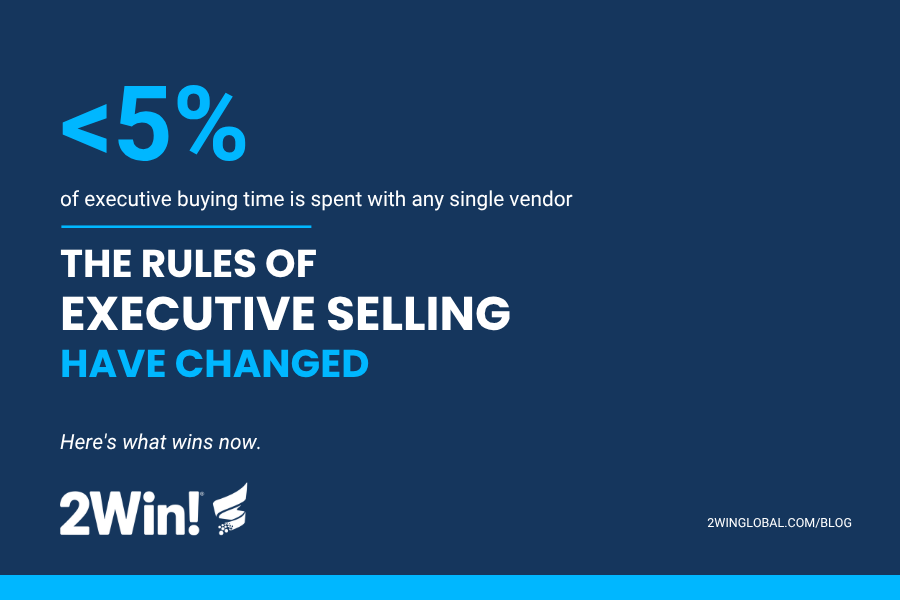
Executive selling has evolved. Learn why traditional preparation fails in high-stakes conversations and what enterprise sales teams must change to...
You and your competitor both walked into the same executive meeting with an AI-generated business case tailored to the exec's industry, company size, and published priorities. The difference?
Your competitor came in with a strong point of view — and you just read your notes.
So, who gets the next meeting?
AI for executive engagement is the use of artificial intelligence tools to research, rehearse, and refine executive-level sales conversations before they happen. And right now, every team with a ChatGPT login has access to the same prep capabilities. That means preparation alone isn't the differentiator it used to be. The differentiator is what you do with it.
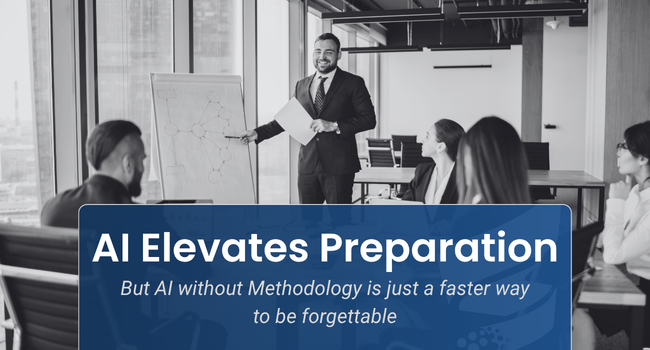
AI elevates preparation. But AI without methodology is just a faster way to be forgettable.
Here's what most teams get wrong about executive meetings: they under-prepare in the areas that matter and over-prepare in the ones that don't. The typical approach looks like this: a seller gets a briefing from their internal sponsor, skims the exec's LinkedIn profile, maybe pulls a recent earnings quote, and walks in thinking they know enough. The sponsor said the CFO cares about cost reduction. Great. But which costs? Tied to which initiative? And how does that connect to what the board discussed last quarter?
In Winning with Executives, we call this the Underknown problem: things you think you know but don't understand well enough. It's the most dangerous category of risk in any executive engagement because it breeds false confidence. You walk in believing you have the picture. You don't. And the executive can tell within the first two minutes. The gold standard for executive preparation is a framework we call Current Position / Desired Position / Impact:
These three questions force a level of strategic clarity that sponsor briefings alone can't provide. AI can absolutely help here. It can research the executive's published priorities, pull relevant data from earnings calls, and draft an initial read on the current position. But only a trained seller can assess that position. That means weighing what the sponsor said against what the data suggests, identifying the Underknown gaps, and building a point of view about what this executive actually cares about versus what the company's press releases say.
The prep work isn't the problem. The interpretation is.
AI is not the enemy of executive selling.
Used well, it's one of the most powerful preparation tools available.
The issue is that most teams stop at the output instead of building on it. Here's where AI genuinely earns its place in executive engagement:
AI-generated business cases. ROI models, competitive comparisons, and industry benchmarks that used to take days to assemble can now be drafted in minutes. That's a real advantage. But only if you pressure-test the numbers against what you know about the executive's priorities and validate them against the Current Position / Desired Position / Impact framework.
Executive presentation rehearsal. AI can generate predictive questions an executive might ask based on their mode tendencies. Will they be in Driver mode (get to the point) or Analytical mode (show me the data)? It can help you stress-test your talking points before you walk into the room. That's preparation you can't afford to skip.
Real-time intelligence from public sources. Earnings calls, investor presentations, analyst reports, and industry benchmarks. AI can surface patterns across these sources that would take hours to compile manually. Maintaining your executive perspective means staying current on what your executive's world looks like, and AI makes that significantly easier.
Scalable coaching and readiness. AI makes executive leadership training more scalable across an organization. Teams can practice against simulated executive scenarios, get real-time feedback on messaging, and build reps without burning live meetings.
Every team now has access to these same tools. McKinsey's research shows that while AI adoption in sales and marketing is near-universal, only a fraction of organizations are seeing meaningful business impact. The tool isn't the edge anymore. Your ability to internalize the intelligence, form a point of view, and execute with precision? That's the edge.
Having a strong POV isn't optional. It's the whole game.
AI can draft your executive summary. It can't read the room when the CFO shifts from Amiable mode to Driver mode three minutes into your presentation.
AI can generate a predictive question for your opening. It can't hear the pause after the executive answers. The one that tells you there's more beneath the surface.
AI can map an org chart. It can't detect the tension between what the VP says publicly and what their team tells you privately.
This is where methodology separates good teams from winning teams.
The Pivot Framework is the ability to listen, paraphrase, clarify, test, adapt, and confirm when a meeting shifts. It's a fundamentally human skill. It requires reading body language, interpreting tone, and making judgment calls in real time. No AI model can do that for you.
Forrester's research confirms it: as AI-generated content floods the B2B landscape, buyers are increasingly turning to human expertise for the deeper validation that closes deals. The organizations winning executive deals right now aren't choosing between AI and methodology. They're using AI to prepare and methodology to execute. That combination is what creates real separation.
AI raises the floor. Everyone gets better preparation, faster research, and more polished materials.
But a unified methodology raises the ceiling. One that teaches your team how to:
The team's closing executive deals aren't the ones with the best AI stack. They're the ones whose preparation is so thorough that their core message becomes automatic, freeing them to adapt when the meeting inevitably goes off-script.
Same game, different level.
Every sales team is investing in AI tools. Fewer are investing in the framework to use it at the executive level. Your competitor has the same AI you do. The same data, the same ROI models, the same meeting prep capabilities. The question isn't whether AI can help you prepare for executive conversations. It can, and it should.
The question is: are you giving your team AI tools without the methodology to turn preparation into presence?
AI won't close your executive deal. But a team that combines AI-powered preparation with a proven methodology for executive engagement doesn't just show up informed. They show up with a point of view — and the agility to defend it when the conversation shifts.
That's the difference between getting a meeting and getting the next one.
Explore Winning with Executives →

Executive selling has evolved. Learn why traditional preparation fails in high-stakes conversations and what enterprise sales teams must change to...

Boost your confidence in executive interactions with practical tips and techniques. Learn how to present yourself, lead discussions, and maintain...

Learn how to elevate your conversations with executives by focusing on strategy, not tactics. This guide offers tips on structuring executive...