.svg "2Win logo25 white (1)")


 2Win!
2Win!
1 min read
Grow Your Confidence In Executive Interactions
Have you noticed that more and more decisions are being made by higher-ups in an organization? As a result, you may find yourself involved in ...
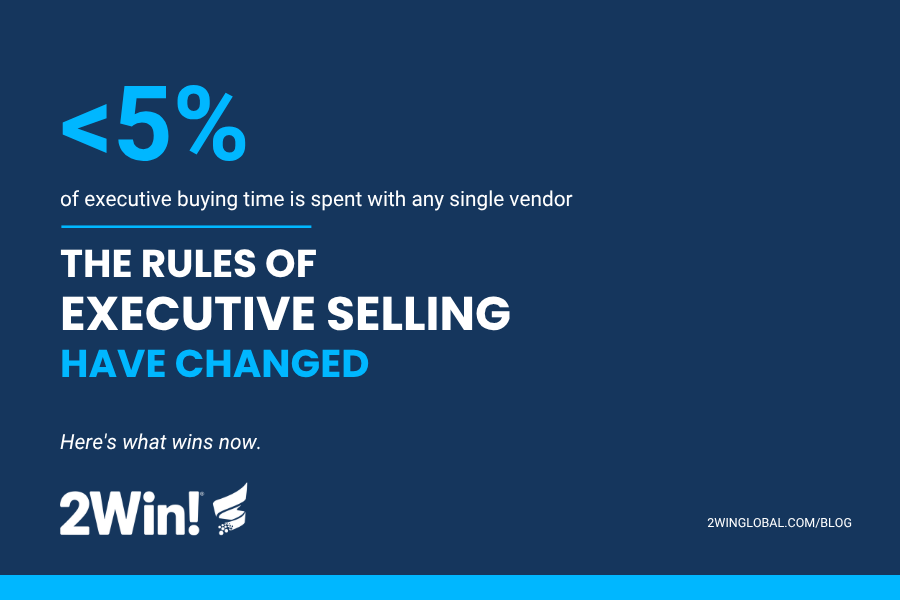
Executives spend less than 5% of their buying time with any single vendor, and that number isn't trending upward.
So when you finally get the meeting, the one your champion spent three months arranging, the margin for error is razor-thin. And the old playbook? Feature decks, sponsor-scripted talking points, a polished "overview" of your platform? That's not what wins anymore.
The rules of executive selling have shifted. Today's high-stakes conversations demand strategic insight, real-time adaptability, and a message sharp enough to land in five minutes if that's all you get.
Here's what's actually changed and what the best teams are doing about it.
The executive calendar has always been competitive. But two forces have compressed it further. First, M&A timelines have accelerated. Executives aren't evaluating vendors in isolation anymore; they're stacking decisions against integration deadlines, board mandates, and competitive windows that didn't exist five years ago. Your "discovery-to-demo" cycle now competes with decisions that have nothing to do with your category.
Second, buyers are more informed than ever. AI-driven research means your prospect's CFO may already know your pricing model, your competitor's positioning, and three analyst opinions before you've opened your deck. The information asymmetry that once gave sellers an edge has flipped. The old bottom-up playbook: win the user, get the manager, hope the VP signs off, still works in transactional deals. But in strategic account conversations, it's a losing strategy. Executives don't want to hear what their team already told them. They want to know what you see that they don't.
That's where communicating business value becomes the new baseline, not a differentiator, a minimum requirement. Think of it as a Value Pyramid: operational details matter to the team, departmental impact matters to the director, but the executive needs strategic alignment. If your message doesn't reach that top level, you're having the wrong conversation in the room.
Most executive conversations don't fail because of bad content. They fail because of weak adaptability.
Here's a scenario every enterprise seller has lived: You've prepared for a 30-minute meeting focused on growth targets. You've rehearsed your ROI-driven sales communication, aligned your slides to the VP's strategic priorities, and briefed your team. Then the executive walks in, announces you have five minutes, and opens with a question about an accelerated M&A timeline you didn't know existed.
What just happened? Three shifts, potentially all at once.
Time Shifts happen when the meeting window compresses. 30 minutes becomes 10, or an hour becomes 25. If your message only works at full length, you're exposed. The teams that win executive presentations prepare for 30, are ready for 15, and know how to deliver in 5.
Mode Shifts happen when the executive's energy or style changes mid-conversation. You prepared for a collaborative, big-picture discussion, but the executive arrives in a data-driven, prove-it-to-me mode. Recognizing this shift and adjusting your delivery in real time is the difference between building credibility and losing the room.
Topical Shifts happen when the executive redirects the conversation to a subject you didn't plan for. Maybe you came to discuss supply chain optimization, and they want to talk about AI-generated business cases for a different division entirely. The content you prepared is suddenly irrelevant. Your ability to pivot is not.
These aren't edge cases. According to research on selling to senior executives, the most common failure mode in high-stakes conversations isn't lack of preparation; it's an inability to adapt when the preparation no longer fits the moment.
The best enterprise sales teams don't just prepare more. They prepare differently.
They build a theme so clear it works in 5 minutes or 30. Think of it like the Carnival of Venice, a jazz piece built on a simple, memorable melody that supports endless improvisation. Elite teams distill their core message into a theme so well-rehearsed that it becomes automatic. That frees them to adapt when the meeting shifts, because the foundation doesn't require thinking — it requires performing.
They lead with predictive insight, not confirming questions.
Most sellers open executive meetings by confirming what the sponsor has already said: "I understand your priorities are X, Y, and Z."
That's not wrong, it's just not valuable.
The best teams lead with a point of view: "We're seeing companies in your space accelerate their AI for executive engagement investments by 40% this quarter. Are you seeing the same pattern?"
That's a predictive question; it shows you've done the work and gives the executive a reason to engage, not just nod.
They never leave without a reason to meet again.
A successful executive meeting doesn't end with "thanks for your time."
It ends with a specific commitment, a next step, an introduction, and a shared deliverable that creates momentum. The ask isn't a formality. It's the entire point of the closing.
AI tools can help teams rehearse these pivots, pressure-test their messaging, and simulate executive scenarios before the real thing. But the tool doesn't replace the skill. AI gives you information. It's your job to bring the point of view.
Here's the challenge: if the executive cut your meeting from 30 minutes to 5, could your team deliver its core message and still walk out with a reason to meet again?
If the answer is "probably not," that's not a preparation problem. It's a capability gap — and it's fixable.
Winning with Executives® is built specifically to equip enterprise sales teams with the frameworks to prepare, adapt, and close in high-stakes executive conversations. Not theory. Not motivation. Method.
Because the executives aren't going to give you more time. The question is what you do with the time you get.


1 min read
Have you noticed that more and more decisions are being made by higher-ups in an organization? As a result, you may find yourself involved in ...

1 min read
Engaging with executives is fundamentally different from our normal interactions, making it feel like a whole new ballgame. We can find ourselves...

1 min read
You and your competitor both walked into the same executive meeting with an AI-generated business case tailored to the exec's industry, company size,...