1 min read
Why Your Demo Isn't Converting: How the Value Pyramid Fixes Your Momentum
The demo went well. The SE executed cleanly. The product looked sharp. Feedback from the prospect? Positive. And then: radio silence. This is one of...
6 min read
2Win!
Jul 6, 2026 2:32:29 PM
You walk into the room, and discovery has gone your way. There's the end user who'll live in the product, the departmental manager who signs off on the workflow, and the exec who controls the budget. You know what each of them said they cared about. You wrote it down.
Then the demo starts, and you talk to all three the same way.
The exec checks out around minute four, because everything you're saying is two levels below the altitude she works at. The end user gets lost when you climb into strategy, because you stopped describing anything he actually does on a Tuesday. The manager in the middle gets neither a number she can defend nor a workflow win she can picture. Nobody got what they came for, and it wasn't because you didn't know better. You knew exactly what each person needed. The plan for moving between them is the part that was never built.
Stakeholder identification isn't something you do while the solution is open. It happens before, on paper, when you decide who in that room sits at which level of the value pyramid.
Gartner puts the typical B2B buying group at six to ten people, each bringing their own research and definition of value. They don't agree with each other by default. Gartner's buyer survey found that 74% of buying teams hit "unhealthy conflict" during the decision, and the groups that reach consensus are far more likely to report a deal they're happy with. Your demo is one of the few moments where you can move several of those people toward the same conclusion at once. That only works if you've decided, ahead of time, which version of the story each of them needs.
The trap is using titles to do it. A "VP of Sales" sounds like a department title, but if everything she said in discovery was about her reps' Monday workflow, she's giving you operational signals. A director can talk like a strategist. An individual contributor can be the one person in the room thinking about the board number. The title tells you where someone sits on the org chart. What they said in discovery tells you what they actually care about, and that's the input you build from.
So build a three-column map before you touch the demo environment. Name and role in the first column. What they said they care about, in their words, in the second. The pyramid level you're assigning them, based on that language, is the third.
Titles are a signal. What someone said in discovery is the evidence.
Here's what that looks like with real discovery quotes:
One more column you can't see in the room: whoever watches the recording later. The demo gets forwarded. The CRO who skipped the live session often scrubs to the last ten minutes. Design your close assuming someone one level higher than your live attendees will review it, because they usually do.
The Closing Tell of a Tell-Show-Tell hands the audience an operational impact. That's correct, and it's where most SEs stop. But there's about a fifteen-second window right after that Closing Tell where you can climb the pyramid without breaking the flow of the demo, and most people walk right past it.
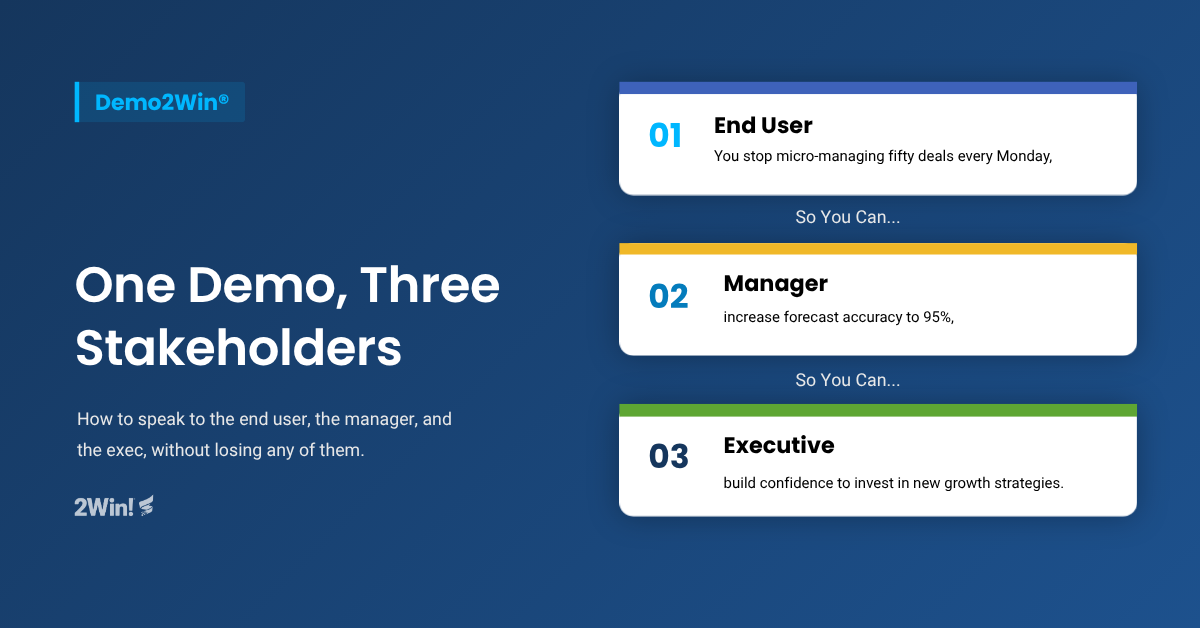
The connector is the "so you can" technique. You state the operational impact, then chain upward: operational result, so you can hit the departmental metric, so you can deliver on the strategic objective.
Said out loud, in one breath, it sounds like this: "You stop micro-managing fifty deals every Monday, so you can increase forecast accuracy to 95%, so you can build confidence to invest in new growth strategies."
Three levels, one sentence. The end user heard his Monday. The manager heard her forecast. The exec heard her board commitment. Nobody had to wonder why the thing on screen mattered to them.
You don't run this chain on every Tell-Show-Tell. If you did, the demo would sound robotic. Pick two or three moments, decide in advance which topics earn the climb, and for which stakeholder you're climbing. The rest of your Tell-Show-Tells can land at the operational level and stay there.
The goal is to make sure everyone in the room clearly understands how your solution helps them acheive their objectives.
Take a revenue intelligence platform with AI-powered deal risk scoring and real-time pipeline health alerts.
Picture a senior AE named Marcus. Every Monday, he opens Salesforce and starts the ritual: scrolls the pipeline, rereads his own notes, checks which opps went quiet, and decides who gets a call. It eats his first ninety minutes of the week, and he's still guessing. So when you demo deal risk scoring to Marcus, you don't say "AI-powered pipeline health alerts." You say: "Monday morning, instead of micro-managing fifty open deals by hand, you open one list. The three accounts that slipped this week are flagged, with the reason next to each. Your gut already knew about two of them. The third is the one that would've surprised you in week six."
Marcus leans in because you just gave him his Monday back.
Now you're across from Diane, the VP of Sales. Diane doesn't care that Marcus triages deals faster. She cares that she stood in front of the CFO last quarter, called $4.2M, and landed at $3.1M. That miss is hers, not her reps'. So you frame the exact same scoring engine differently: "Your forecast pulls from rep-entered confidence, which is optimism with a deadline. This scores every deal on actual buyer behavior: email cadence, stakeholder spread, Gong call signals. Teams using it tighten forecast accuracy inside two quarters. The number you defend to finance stops being a guess."
Same feature. Different accountability.
Then you get the CRO, Ray. Ray will never look at a deal score. What's on his mind is the thing he told you in discovery: the board sets the number, and he has to commit to it before he knows if it's real. So the feature nearly disappears. "Ray, you told me the hardest part of your job is committing to a board number you can't fully back yet. What we've shown your team changes what that commitment rests on. You'll walk into the boardroom committing on data, not optimism."
You barely mention scoring. You name the tension he already feels.
Here's the principle underneath all three. Marcus is accountable for his own work, so you speak to him about his week. Diane is accountable for her team's metrics, so you speak to the number she has to defend. Ray is accountable for what the organization promised the board, so you speak to the promise. The feature never changed. What changed is whose neck is on the line, and you matched your language to it. That's what a buyer-centric demo actually is: the same software, aimed at the accountability each person carries.
That's the part people miss when they think this is just swapping vocabulary. Each person is motivated by relief from a specific kind of exposure. Marcus wants to stop guessing. Diane wants to stop missing. Ray wants to stop committing on faith. When your framing lands on the exposure that keeps that stakeholder up at night, you're not describing a feature anymore. You're describing their problem, solved, and that's the conversation that moves deals.
Many SEs do one of two things with the Value Close. They skip it, or they turn it into a four-minute summary nobody asked for. Both waste the ninety seconds that do the most work in the whole demo. It's the moment your demo persuasion skills get the opportunity to shine.
A Value Close does four things. It revisits the theme from your Limbic Opening, so the demo lands where it started. It states the Key Departmental Impact, the one metric the manager carries. It provides proof, a number, or a customer quote that makes the claim stick. And it transitions cleanly to the account owner to carry the deal forward.
You can touch all three pyramid levels inside that window if you pace it correctly. Name the operational impacts quickly, in 10 seconds, with no replay of what they already watched. Climb to the departmental impact with a "so you can." Land one strategic sentence that points straight back at something the exec named in discovery. Then bring the proof. That's the whole structure, and it fits in ninety seconds if you've decided the words in advance.
Remember who's watching after the fact. The Value Close is the part that gets forwarded. The departmental impact has to be clear enough for your champion to repeat it in a hallway without you there. The proof has to be specific enough to survive the retelling. Write the close as if you're handing your champion a script, because functionally, you are.
Write the Value Close as if you're handing your champion a script to justify the deal. Because you are.
Before your next mixed-room demo, run your plan against these:
If you can answer all three, you've built the space to shift on purpose, which is the whole job.
1 min read
The demo went well. The SE executed cleanly. The product looked sharp. Feedback from the prospect? Positive. And then: radio silence. This is one of...
1 min read
Two sales teams. Same product. Same quarter. Radically different results.