.svg "2Win logo25 white (1)")



 2Win!
2Win!
How Does Basketball Translate Into Winning with Executives?
John Coker breaks down his experience as a professional athlete and how he translated lessons learned on the court into the world of Sales with...
We've seen it before:
An executive who first crushed it as an individual contributor, led high-performing teams as a manager, and earned their seat through consistent results, not luck.
And now, they're "busy." Always in the middle of everything. Firefighting. Jumping into decisions their team should be able to handle. Wondering why performance feels harder than it should at this level.
Here is the leadership reality that's easily forgotten: You didn't get here by accident. But the skills that got you here will not sustain you here.
At the executive level, success stops being about personal heroics and becomes about something else entirely: creating the conditions where your team can be the hero. That is where the 2% performance edge comes in.
Not massive overhauls. Not flashy transformations.
Small, intentional shifts in how you lead that compound into extraordinary results.
Many executives believe they are being clear, but really they're being abstract. Teams rarely fail because they're incapable. They fail because they don't know what “good” looks like.
When direction is fuzzy:
People work hard on the wrong things
Priorities compete instead of align
Anxiety rises and confidence drops
Ambiguity does not inspire ownership. It creates hesitation.
Clarity is not about saying more. It is about saying less, better.
At a minimum:
Your team should be able to explain the vision in their own words. This isn't parroting back a memorized mission statement, but articulating what you're building and why in a way that makes sense to them.
Everyone knows how their work connects to the bigger picture. They can draw a direct line from their daily tasks to the outcomes that matter.
Success criteria are specific, not subjective. People know exactly what "good" looks like and can measure their progress without guessing.
Three ways to sharpen clarity immediately:
Ask team members what they believe the top priority is. If you hear five different answers, the message is not clear enough.
If you cannot articulate your quarterly focus in three sentences, simplify.
Every "yes" is also a "no." Say both out loud. Focus creates trust.
As Brené Brown puts it, “Clear is kind. Unclear is unkind.”
When people know what is expected, they don't wait for permission. They move with confidence and innovate within clear boundaries. When expectations aren't clear, you'll find yourself repeating the same explanations, resolving the same conflicts, and wondering why execution feels so hard.
You're accountable for results. But you can't do the work yourself.
That tension causes many leaders to swing between two extremes:
Hands off and disconnected
Or deeply involved to the point of micromanagement
Neither scales.
Elite executives do not build the road themselves. They remove obstacles so others can move faster.
Ask regularly, “What is in your way?” Then act on it. Budget, alignment, authority, access.
You create a framework that speeds everyone up.
People make better decisions when they understand why. Share market shifts, leadership priorities, and constraints openly.
Align on the approach. Set milestones. Review outcomes. Let go of constant oversight.
And invest in enablement.
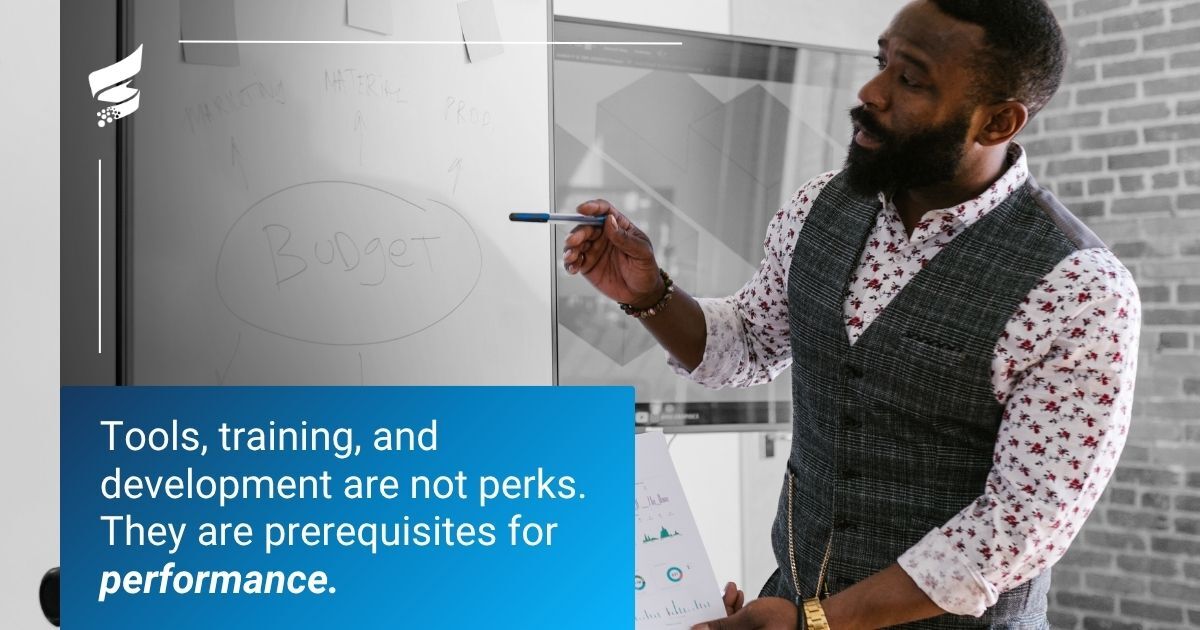
Tools, training, and development are not perks. They are prerequisites for performance.
If you are deep in the weeds everywhere, ask yourself this question. Is this about necessity or trust?
Often, the answer reveals a clarity gap, a hiring issue, or an ego check.
Accountability without support feels punitive. Support without accountability creates complacency.
Elite leaders hold both.
Accountability works when it's predictable and fair.
Don't assume people know. Spell it out. Metrics. Behaviors. Outcomes.
When expectations are explicit, feedback becomes objective and progress becomes measurable. Clarity removes guesswork and gives high performers something concrete to aim for.
Weekly one on ones. Monthly reviews. Quarterly check-ins. Consistency matters more than intensity.
These rhythms create space for course correction before small issues become big ones, and they normalize accountability as part of how the team operates, not something reserved for problems.
Waiting until reviews is too late. Address issues early, clearly, and respectfully:
What was observed
The impact
What needs to change
Public recognition sets the standard. It signals what “good” looks like and reinforces the behaviors worth repeating.
Coaching happens privately. Real growth requires clarity, respect, and trust—not an audience.
And sometimes, leadership means making hard calls.
A high bar protects your best people. It keeps standards clear and performance strong. Delaying tough decisions doesn’t preserve culture, it erodes it.
Elite leaders don’t avoid accountability. They apply it consistently, in service of the team and the results.
Many executives chase immediate results when they should chase consistent improvement.
James Clear captures this perfectly. Daily improvements compound into remarkable results over time.
At the executive level, the mindset shift is critical:
From hero to architect
From problem solver to system builder
From individual excellence to team excellence
When this clicks:
You are not in every meeting. Your team is.
You are not the bottleneck. You are the accelerant.
Performance becomes cultural, not dependent on you.
That is how organizations scale.
You have already proven you can perform.
The real question now is this: can you create the conditions where everyone around you performs at their best?
Pick one area for the next 30 days:
Clarity: Ask your team to articulate the top priority. Listen for gaps. Take ownership of any discrepancies.
Enablement: Ask what is blocking great work. Remove one obstacle. Ask yourself "am I getting in the way?"
Accountability: Review how often you give feedback. Tighten the loop.
The 2% edge is not flashy. But six months from now, your team will look effortless from the outside.
And you will know why.
Remember: the best teams don't have heroic executives. They have executives who make everyone around them feel like the hero.

John Coker breaks down his experience as a professional athlete and how he translated lessons learned on the court into the world of Sales with...

Executive selling has evolved. Learn why traditional preparation fails in high-stakes conversations and what enterprise sales teams must change to...
Avoid executive misalignment by ensuring clarity in communication. Shift from a self-centered to a customer-centric approach for more productive and...