Skip to the main content.
Book a Meeting Online Learning

6 min read

SKO or Bust: Your Team Flies Home Fired Up. Then What?

SKO or Bust: Your Team Flies Home Fired Up. Then What?

Watch the Full Video

The keynote lands well. The breakout sessions run long because people are genuinely engaged. Your team flies home fired up.

Then mid-February arrives. The demos look the same. The discoveries sound the same. Pipeline behaves the same.

Bad planning doesn't explain it. Neither does budget or the wrong speakers. The gap between a kickoff that energizes and one that changes how your team sells isn't visible during the event. It shows up on Monday morning, and every week after that.

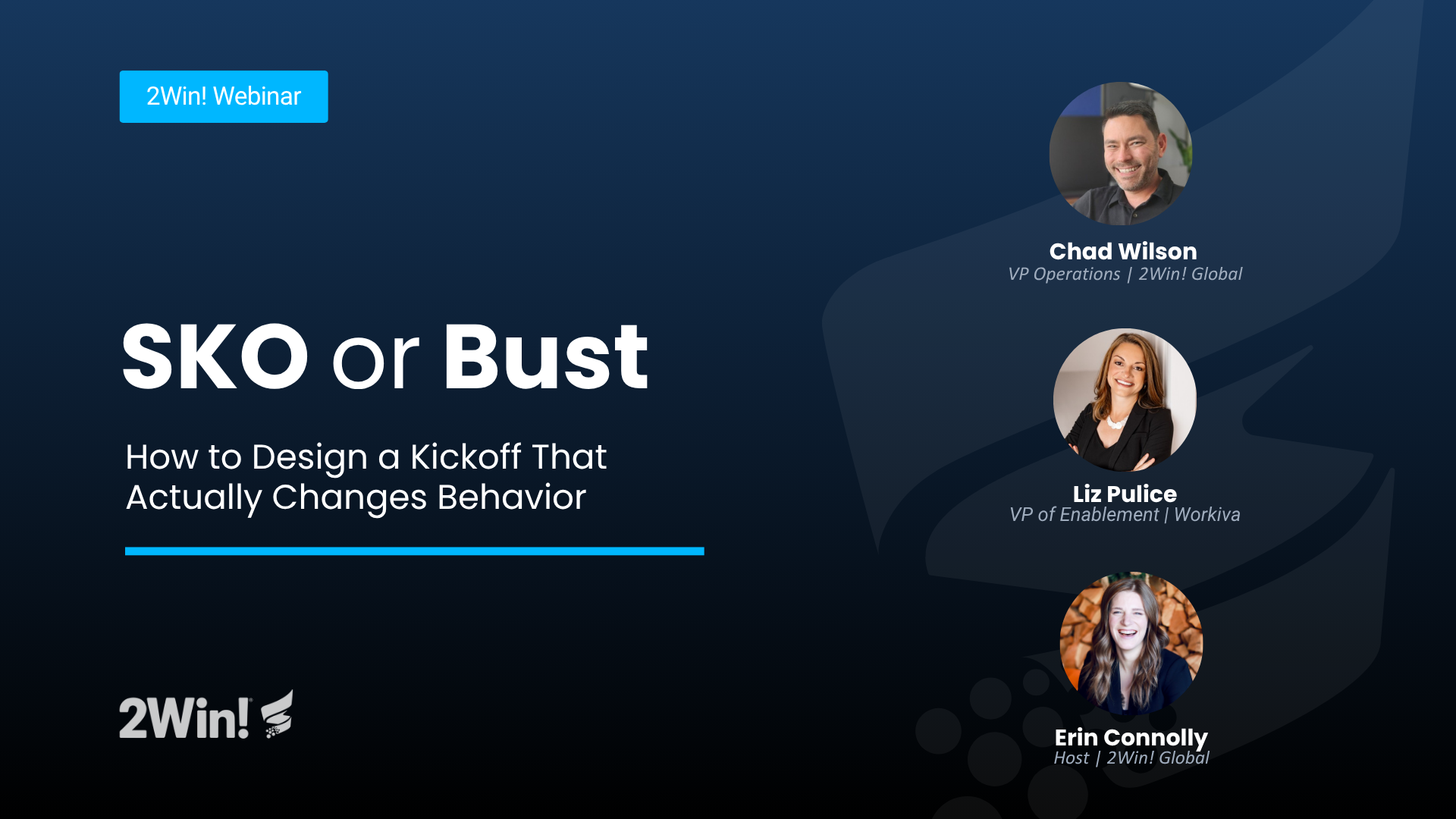
2Win! GlobalCOO, Chad Wilson, and Workiva VP of Enablement, Liz Pulice, joined us for the SKO or Bust webinar to talk about exactly this problem. Not the logistics. The design decisions that determine whether your SKO is still working in Q3.

Here's what they said.

The Question Most Revenue Leaders Skip

When a revenue leader starts planning an SKO, the first question is almost always: what do we need to communicate?

Product updates. Messaging shifts. Go-to-market priorities. The list builds. The agenda fills. Every leader in the org wants a slot.

The teams that drive real behavioral change at SKO start with a different question: what do we want people to think, feel, and do as a result of this?

It sounds like a subtle reframe. It isn't.

"What do we need to communicate?" produces an information transfer. "What do we want them to think, feel, and do?" produces an experience designed around an outcome. One ends with a packed agenda. The other ends with changed behavior.

Liz frames it this way for her organization: before anything gets on the agenda, she's asking what sellers need to do differently this year to make their numbers. Not what has changed. What needs to change about how they operate to hit the revenue plan they've publicly committed to in Workiva's case?

That becomes the filter. Not "is this important?" Everything in that room is important to someone. The filter is: does this change behavior? And if the honest answer is no, it belongs in pre-work or a follow-up, not in the program.

Why Deals Are Stalling Right Now

and What That Means for Your Agenda

Chad flagged two patterns that are showing up across 2Win's clients and should directly shape what your SKO teaches.

First: executives are more involved in deals than they were even three or four years ago.

Sellers are having C-suite conversations at an intensity they weren't trained for. Talking to a line-of-business VP is not the same as talking to a CIO. Both require different framing, different preparation, and a clear sense of what the person across the table actually cares about at their level of the organization.

Second: deals are dying in later stages more than they used to.

And qualification isn't the culprit. Value justification is. The "go-do-AI" mandate that pushed spend regardless of defensible ROI is largely gone. Buyers want purpose-built solutions they can justify, and sellers who spent the last year over-rotating toward cool new capabilities are now working to get back to a core story they can actually defend.

What this means for your SKO is concrete. Discovery skills matter more than ever, not as a phase to get through, but as a sustained practice sellers need to be more patient with. And executive fluency is no longer a top-performer differentiator. It's the floor.

Liz put it plainly: "Our sellers need to spend more time in discovery than they've ever spent, and that's uncomfortable. Velocity has been the name of the game for so long."

If your SKO doesn't address those two gaps, discovery depth and executive fluency, in a way that produces different behavior after the event, you've missed the primary ROI opportunity in front of you.

The Format Decision That Quietly Kills ROI

Chad calls it "presenter slop."

Not AI-generated content specifically. Content that was shaped by AI, never internalized by the presenter, and delivered as-is. The slides give it away. The delivery confirms it. The person on stage hasn't made the material their own, and an audience of hundreds or thousands can tell.

"It communicates to the audience that you did not care enough to internalize this message yourself," he said. At an event this expensive in both hard cost and opportunity cost, that's a significant signal to send to your team.

The fix isn't to avoid AI. Use it to shape, draft, and structure — then finish the work. Put your own experience, your own stories, and your own perspective into it. The best SKO presentations don't feel like presentations. They feel like someone with hard-won perspective actually talking to you.

A few other format calls worth making early:

Keep the go-to-market tech stack off the main stage.

Salesforce, LinkedIn Sales Navigator, your CRM workflow updates- these are great tools that don't show well to a thousand people in a ballroom. Sellers use them on laptops. Put them in a breakout or push them to pre-work.

Build in big-to-small rhythm.

A main-stage message lands differently when it's immediately followed by a role-specific breakout where sellers apply it in the context of their actual jobs. Workiva runs about 20 breakout rooms at their SKO to deliver customized content for each of the 22+ roles they serve. The number isn't the point — the principle is.

Protect the unstructured time.

When Workiva surveys sellers after every SKO, the consistent feedback is: "I wish I'd had more time with my team." Not at the party. In a room, working through problems together. Remote work has made in-person proximity genuinely valuable. Don't fill every minute. Leave space for it to breathe.

Reinforcement Isn't a Follow-Up. It's Infrastructure.

"An organization will fall back to the level of its systems, not always its people."

Chad said this about frontline managers, and it's the frame that makes the whole conversation click.

The frontline manager is where SKO investment either compounds or evaporates. They're the ones who can reinforce a skill in pipeline reviews, in one-on-ones, in deal prep. But two things have to be true: they need to know what they're reinforcing, and the systems around them have to make reinforcement natural.

Liz is direct about the operational reality: get it on their calendars before the event ends. Not a Slack message with good intentions. Actual calendar holds. Actual frameworks for how to work the activities into their team's operating rhythm — team meetings, pipeline reviews, forecast calls, coaching sessions.

The other piece is leadership consistency. When the same messages emphasized at SKO keep showing up in all-hands and leadership communications for the next six months, it signals to the organization that the kickoff wasn't a moment. It was a plan.

One more thing worth naming: the best frontline managers coach their teams so they can scale. Most get pulled into deal work instead. When push comes to shove, they help close the deal rather than build the skill that would let the rep close without them. Recognizing that pull and installing systems that work against it are part of what separates SKOs that change behavior from SKOs that expire by Q2.

The practical implication is to install the operating system before the event, not after. By the time your team lands home Monday, the reinforcement infrastructure should already be live.

The Ratio Question

At the end of the webinar, we asked Liz and Chad directly: What's the right ratio of inspiration to skill-building?

60% inspiration, 40% skill-building. Salespeople are very human. They need to feel the emotion and the community before they'll do the work. -Liz Pulice

Chad landed close to 50/50, but with a broader definition of what counts as skill development. In his framing, it doesn't require a formal exercise. It includes discussion questions during transitions, a Slack thread to extend the conversation, and a five-minute pair application of what was just heard on stage. That kind of application is available to any audience size, and it creates channels for sellers who are more introverted or for whom English isn't a first language to engage without the pressure of a public role-play.

Both answers point to the same underlying principle: inspiration without application doesn't produce change. An application disconnected from motivation doesn't stick. The sequence matters, the ratio matters, and neither should be filled with whatever time is left after the main stage program is booked.

It's Never Too Early

Kelly asked during the live Q&A whether it was too early to start planning if budget hadn't been approved yet.

Liz's answer: never too early.

Before budget is approved, you can dream. What would be genuinely inspiring? What worked last year, and what didn't? What's the best version of this event if nothing is off the table yet? That thinking, before the constraints land, gives you something real to work from when the CRO calls in August, asking what you're doing for kickoff.

Chad's read: mid-size to enterprise companies hosting large-scale events are already in planning conversations. Not at execution level. At the vision and relationship level. The elements that make a kickoff feel cohesive — a real theme, imagery that carries the message through everything, a service project tied to the narrative — don't come together in a few weeks. They come together over months of thought and iteration.

And one practical note on early planning that Liz made: starting early also gives you time to think about your venue's actual capacity for what you want to do. Twenty breakout rooms require a different conversation with your venue than two breakout rooms do. That conversation needs to happen before you've signed anything.

One Place to Start

If your SKO is coming up and you're working through these design decisions — what goes on the main stage, how to structure the breakouts, what reinforcement looks like on Monday — we've put together a 2027 SKO Planning Guide built around the frameworks covered in this webinar.

Get the Replay

Sales Kickoff Success 2024- Choosing the Right Keynote Speaker

1 min read

Sales Kickoff Success 2024- Choosing the Right Keynote Speaker

Ahhh, the glory days of a sales kickoff (SKO), where hundreds or even thousands meet for an energizing five days in places like Las Vegas, Singapore,...

Read More
Add Some SPICE to Your Virtual Sales Kick Off

1 min read

Add Some SPICE to Your Virtual Sales Kick Off

Virtual Sales Kick Off (SKO) season is about to begin and, if you’re like many powerful sales organizations, you’re looking for big results...

Read More
Sales Kickoff Success 2024- Soft Skills Training

1 min read

Sales Kickoff Success 2024- Soft Skills Training

In Part 1 of this series, we focused on how you can ensure the success of your Keynote speakers. In part two of this series, we will explore why an...

Read More