1 min read
Why Your Demo Isn't Converting: How the Value Pyramid Fixes Your Momentum
The demo went well. The SE executed cleanly. The product looked sharp. Feedback from the prospect? Positive. And then: radio silence. This is one of...
5 min read
2Win!
Jul 17, 2026 12:00:00 AM
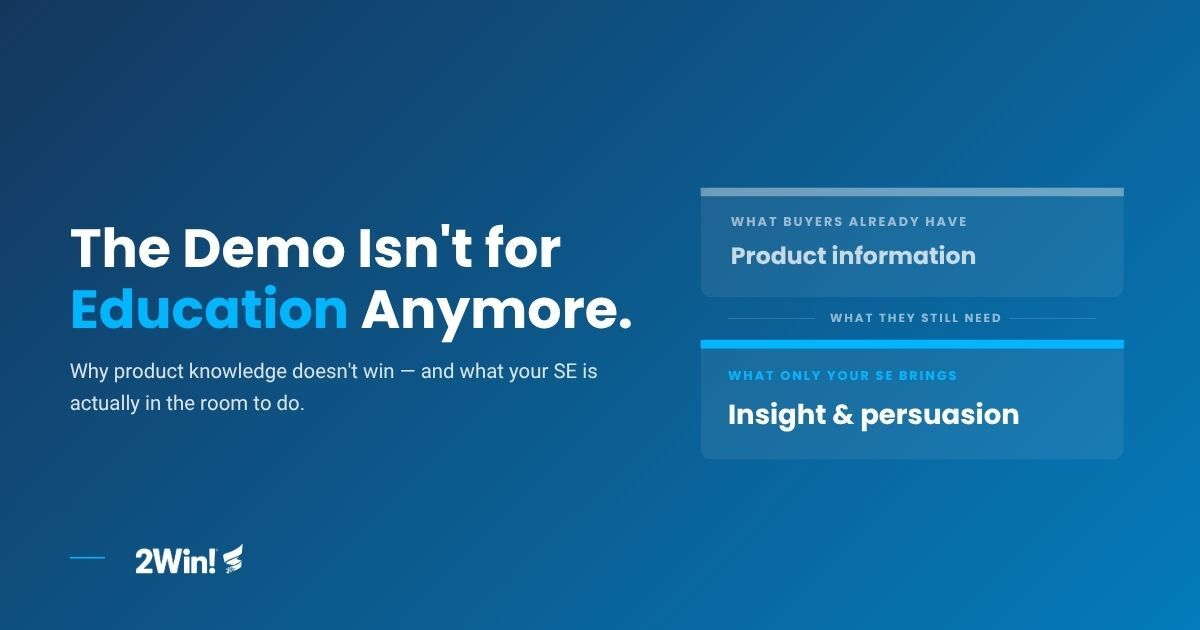
Your SE jumps on the call. The prospect has already watched the interactive product tour, run a competitive comparison through an AI tool the night before, and walked in with a shortlist that already includes you. They've seen the interface and know roughly what the thing does. They're not on this call to find out.
Your SE does what good SEs are trained to do. Opens the platform, walks through the capabilities, and builds toward the part of the product they're proudest of. Forty minutes of well-rehearsed coverage. The buyer nods, says thanks, and goes quiet for three weeks.
That instinct, the one that says "show them more features," is the problem. Your SE didn't fail to communicate the product capabilities; they did that perfectly. But the purpose of the demo has changed.
The buyer's research stack barely resembles what it was five years ago. Before a single call gets booked, they've clicked through an interactive demo on Navattic or Consensus, read the G2 grid, watched a teardown on YouTube, and asked an AI tool to summarize how you stack up against the two competitors they're also evaluating. By the time your SE says hello, the buyer has done a real chunk of their homework, most of it aimed at one question: does this thing actually fit what we need?
Gartner's research puts a number on how little of the journey you actually see. B2B buyers spend roughly 17% of the total purchase process meeting with potential suppliers, and when they're comparing several vendors, the time any one rep gets shrinks further. The rest of the decision happens in rooms you're not in.
The information gap that demos used to fill, the one where the buyer genuinely didn't know what your product could do until you showed them, is mostly closed before your SE opens their mouth. Which raises an uncomfortable question for anyone running an SE org: what is your team actually bringing to that call?
While the gap in capabilities has closed, it remains wide open when it comes to interpretation. Buyers can pull product specs from a dozen sources. What they can't get from a tour, a grid, or a chatbot is a point of view on how to think about their problem, which tradeoffs matter for a company shaped like theirs, and what solving it well actually looks like.
That's not information. That's judgment, and it only comes from you.
Look at how most SE teams still get ready to sell. The SKO opens with a product keynote and a roadmap deep-dive. Certifications are pegged to release cycles. New hires are deemed "ramped" when they can fluently demo every module. Readiness, in practice, gets measured by how well someone knows the product.
Under it all sits one assumption that nobody says out loud: the buyer doesn't know enough yet, and if we can just get them properly informed, they'll see why we're the right call. Train the team to transfer product knowledge cleanly, and deals will follow.
That assumption was reasonable when information was scarce. It isn't anymore. Buyers arrive informed, sometimes more current on your release notes than the rep across the table.
The thing standing between you and the signature isn't a knowledge deficit on the buyer's side.
When the gap isn't knowledge, more knowledge doesn't close the deal.
None of this is a knock on enablement teams, who are running hard and building real programs.
It's a structural mismatch.
The machine was tuned to close an information gap that the market already closed for free. You can run that play flawlessly and still lose, because you're answering a question the buyer stopped asking.
If the demo isn't for education, then strip that job away and look at what's left. The buyer knows what the product does. What they haven't worked out is whether it solves their problem, in their environment, against their constraints, better than the other logo on the shortlist. That's the gap your SE is there to close. Call it what it is: persuasion.
Not persuasion in the slick, manipulative sense. Persuasion is the work of connecting a capability to a specific business outcome that this buyer cares about, in real time, and giving them a way to think about their problem they didn't have when they walked in.
The best SEs don't just show how the feature works. They show the buyer a path through their own problem that the buyer hadn't seen yet, using the product as the vehicle.
That's a different skill from knowing the product cold, and it's worth being honest that they're not the same thing. Deep product knowledge is the foundation for persuasion, but not persuasion itself. Plenty of SEs who can recite every configuration option still can't read the room when it's going cold and adjust, can't elevate a tactical feature to a board-level outcome on the fly, can't structure thirty minutes so the buyer leaves with a decision instead of a stack of information.
Persuasion is the only part of the demo AI can't run for you.
This is the line the buyer's tooling can't cross. An AI copilot in the buyer's stack can surface features, generate a comparison, and even draft objections to bring to the call.
What it can't do is sit across from a skeptical VP, sense the moment the energy shifts, and reframe the conversation so it lands. It can't earn trust or build the momentum that turns "interesting" into "let's move."
That work is human, and it happens live, or it doesn't happen at all.
Demos are subjectively judged events. Two vendors can show near-identical capabilities and walk away with opposite outcomes, because the buyer isn't scoring a feature checklist; they're reacting to how the whole thing made them feel about the decision.
In a field that close, the margin between winning and losing is approximately 2%, and that 2% is execution, not functionality.
Which is exactly where persuasion stops being a personality trait and becomes a trainable architecture. A few of the moves that make the difference:
Picture the same capability run two ways. One SE opens the reporting module and starts clicking through filters, narrating fields as they go. The other says, "Your team told us month-end close takes four days and your CFO wants it down to one, so watch how fast this gets you there," then shows the same screens, then closes with "that's three days a month back, every month."
Identical software. One of those rooms moves forward.
These aren't soft skills you hope someone picks up by watching a senior rep. They're a repeatable system for creating conviction, and a team can be trained to run it the same way they were once trained to run the product walkthrough.
Here's the question to take back to your next enablement planning session. If your team's readiness is still built around product depth, release-keyed certifications, and ramp measured by feature fluency, then you're optimizing for a buyer journey that no longer exists. You're getting very good at closing a gap that the market has already closed.
The teams winning in compressed buying cycles aren't winning on features. They're winning through persuasion, through the ability to manufacture conviction within a thirty-minute window that's getting shorter every year.
Demo2Win was built for this moment, though not because it's new. It's been built around persuasion over product knowledge from the start, which means it anticipated the commoditization of information by never treating information as the thing that wins. The market just caught up to the premise.
So before you lock the next training cycle, ask the question your team's calendar can't answer for you: what is that training actually for? If your honest answer is "making sure they know the product," it might be worth asking what your buyers already know before the call starts, and what they still can't get from anyone but the person you put in the room.
1 min read
The demo went well. The SE executed cleanly. The product looked sharp. Feedback from the prospect? Positive. And then: radio silence. This is one of...
1 min read
Two sales teams. Same product. Same quarter. Radically different results.
1 min read
Your AI Is Only as Good as What You Teach It The question used to be: should we use AI in our demo prep workflow? That conversation is over. Every...