.svg "2Win logo25 white (1)")


 2Win!
2Win!
Tell-Show-Tell: The Most Powerful Demo Technique
Tell-Show-Tell: A powerful approach for software demos. Learn how to simplify your demos with 2Win's tell show tell method.

You covered every feature. You hit every talking point. The prospect said, "This looks great. We'll be in touch."
Then nothing.
Here's the structural reason why: your demo informed the buyer. It didn't move them. And those are two completely different outcomes.
Many sales engineers believe the quality of a demo lives in the product, in the polish of the UI, the depth of the feature set, the smoothness of the walkthrough. But buyers aren't judging your software against a technical rubric. They're asking one question, usually unconsciously, throughout every minute of your demo:
Why does this matter to me?
If you're not answering that question, before they have to ask it, you're losing ground you don't even know you're ceding.
Tell-Show-Tell is the structural fix.
There's a pattern that shows up in the majority of software demos, and it has a name in the Demo2Win methodology: the Show-Tell-Tell crime.
It goes like this: The demo starts. The SE shares their screen, opens the product, and begins navigating and explaining features as they go, adding context mid-demonstration, stopping to say "let me back up and tell you why this matters." The audience watches. They nod. They can't connect what they're seeing to anything they actually care about.
The problem isn't the product. The problem is sequencing.
Humans don't process information in a neutral, rational order. Before the neocortex, the analytical, logical part of the brain engages with what you're showing, the limbic system has already run a relevance filter:
If the answer is unclear, attention drops. Buyers disengage, defer, or default to the status quo. Not because your product wasn't impressive, but because their brain never got the signal to care.
"A wealth of information creates a poverty of attention." -Herbert Simon
Opening with the product before establishing relevance is like starting a story with the punchline. Technically, the information is there. But the audience has no frame to receive it.
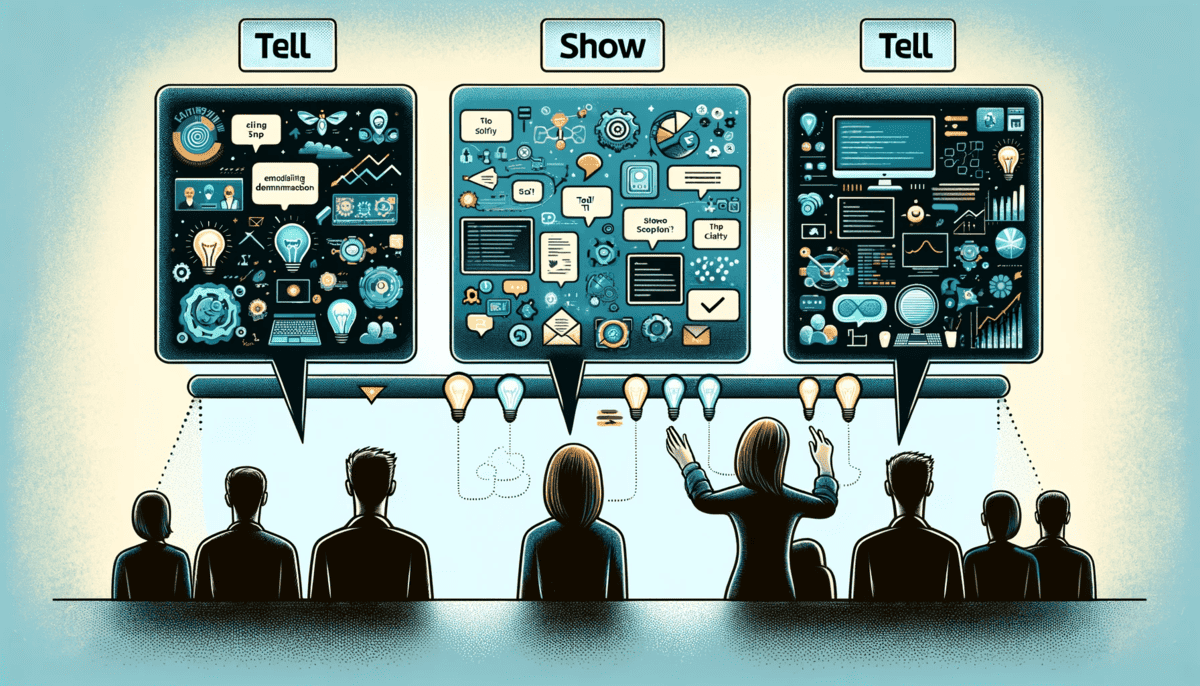
Tell-Show-Tell is a core delivery technique in Demo2Win. It is a three-phase structure applied to every topic in your demonstration. It follows the sequence of Context → Capability → Impact.
Think about how a sports commentator works. Before a skier drops into a halfpipe run, the commentator sets the stage: "She's currently in second place. Watch her second trick, that's her signature move. If she lands it clean, she takes gold." Then the athlete hits the run, and the commentator reacts: "She stuck it. That's going to be hard to beat."
You knew what to watch for. You saw it happen. You understood what it meant. That's structure and Tell-Show-Tell brings the same discipline to your demo.
Here's the critical distinction most people miss:
Tell-Show-Tell is not "tell them what you're going to show, show it, tell them what you showed."
That version is just narration. A feature tour with a little structure around it. The real Tell-Show-Tell is built around relevance, proof, and impact.
The Opening Tell isn't a table of contents. It's a relevance trigger. The Closing Tell isn't a summary. It's the business headline your audience will actually remember after the call ends.
That distinction is the difference between a demo that informs and a demo that moves deals forward.
The Opening Tell happens before the product is ever on screen. It accomplishes three specific things:
The Opening Tell answers the audience's silent question "Why should I care about this?" before they have to ask it. If you skip it, they ask it anyway. Mid-demonstration. While you're navigating. And you can't hear them.
The Show is the actual product demonstration. Keep it clean.
Your goal is not to teach the audience how to use the software. It's to show them what becomes possible when they do. In practice, that means:
The Closing Tell is the most underused, highest-leverage part of the framework.
Briefly recap the capability demonstrated, then deliver the Key Operational Impact (KOI), a three-words-or-fewer phrase that crystallizes the operational value of what was just shown:
The KOI is what the audience remembers. Without it, the Show ends and the audience forms their own conclusions — which may not match your intended message.
Here's how it executes on a concrete topic. Walk through it before your next call.
Topic: Automated Approval Routing
Opening Tell:"During our discovery call, you mentioned your team spends about three hours a week manually routing approval requests across managers and finance and that deals are sometimes stalling while they wait. I'm going to show you how automated approval routing works in [Product]. It takes about 60 seconds to configure, and it eliminates that manual bottleneck entirely. Watch specifically for what happens when a request crosses a dollar threshold, that's where the time savings really show up."
Why it works: the situation is grounded in something the audience actually said. The pain is named. The Show is previewed. The moment to watch for is called out before a single screen appears.
Show: Walk through three steps, sprinkling the operational benefit behind each as you go:
Stop there. Resist the pull to show every configuration option. Your goal is to demonstrate what becomes possible, not teach them to build it.
Closing Tell:"So what you just saw is automated approval routing, from request to approval in under two minutes, with zero manual handoffs.
For reps, that's three hours back every week they're currently spending on admin so you can spend that time on active deals instead of chasing approvals.
For your managers, every approval is tracked and visible in real time so you can hit cycle time targets and keep deals moving without a single status meeting.
And for your leadership team, that's full pipeline visibility and predictable deal flow so you can forecast with confidence and make resourcing decisions based on what's actually happening in the business, not what you think is happening.That's the impact across your org on day one. Next, I'll show you how audit and compliance tracking builds on this same foundation."
Notice how the Closing Tell stacks impact across the Value Pyramid, from operational (reps) to departmental (managers) to strategic (leadership). Each "so you can" hands the impact up one level until it lands somewhere an executive actually cares about. By the time it ends, every person in the room has heard their version of the value and leadership has a reason to champion the deal internally.
The framework is straightforward. The execution is where things break down.
Here's what accumulates over the course of a well-executed demo: a portfolio.
Each Closing Tell anchors a KOI. After three to five topics, the audience has a stack of concrete operational impacts, not a vague impression of a feature-rich product. That portfolio is what makes the Value Close possible, and what makes the next-step conversation easier, because the buyer isn't trying to reconstruct value on their own after the call.
The 2% factor in competitive deals isn't talent. It isn't timing. It's whether the value was framed clearly enough to be remembered and repeated inside the buying organization.
Most demos show the same features. The margin between winning and losing lives in how compellingly the outcome is delivered. Tell-Show-Tell is that margin.
Tell-Show-Tell is the foundational technique inside Demo2Win – the hands-on methodology used by sales engineers at leading SaaS companies to structure, deliver, and close more effectively.
[Download the Product Demo Mastery Checklist]

Tell-Show-Tell: A powerful approach for software demos. Learn how to simplify your demos with 2Win's tell show tell method.

Enhance your software demos with the proven Tell-Show-Tell technique to engage stakeholders, simplify complex features, and drive deals forward....

Master the Tell-Show-Tell method to structure your demos effectively, engage your audience, and drive them towards your solution! 2Win! Presales...