Skip to the main content.
Book a Meeting Online Learning

7 min read

Anatomy of a Winning Demo: What 2Win Coaches See Across Hundreds of Demos

Anatomy of a Winning Demo: What 2Win Coaches See Across Hundreds of Demos

Watch the full Webinar:


The invite lands on a Thursday. Sixty minutes, fourteen people accepted, and you only recognize four of the names. Luckily, one of them is your champion. There is also someone from IT security, two people whose titles include the word "operations," and a VP who accepted eleven minutes before the call started.

You've built the environment and tailored the data. You know exactly which three capabilities your champion asked to see, but somewhere in the back of your mind, you know that half the room has no idea why they're here.

That gap, between the demo you prepared and the room you actually walk into, is where good deals go quiet.

A winning demo earns the room in the first 90 seconds, shows only the three to five topics that move that specific deal, and keeps the buyer engaged. Across hundreds of coached demos, 2Win coaches see the same three habits separating demos that advance deals from demos that simply finish.

We put three of those coaches on a panel to talk about it:

  • Chad, 2Win's chief operating officer and go-to-market transformation lead.
  • Taunya, a master coach who spent more than 20 years building learning organizations inside the distribution software industry.
  • Jodi, a facilitator who spent eleven years casting reality television for CBS, including Survivor and The Amazing Race, before she started coaching sales teams.

Trend one:

The opening that never earns the room

Demos still open with an agenda slide. Sometimes it's a company overview, sometimes a product tour, but the structural move is the same: the first few minutes go to housekeeping instead of the business problem the room came to solve.

Taunya said, "We are in such an attention-deficit society now. You really only have that ninety seconds to set that hook." If the opening isn't about the audience, she says, you've already lost the people you most needed.

Jodi sees the agenda slide as more of a comfort blanket than a choice. It settles the nerves and puts the presenter in charge for a minute, and it also skips the part that matters. "Nobody comes in and gets cast for a role by saying, 'This is what you're about to see me do'," she said. "They get the role by capturing attention in the first 30 seconds. You buy in, and you believe it."

Taunya added this point of view: every Demo Crime comes from a good intention. The agenda slide exists because you planned carefully and you want the room to know it. The intent is good. The execution just lands somewhere else.

Chad framed the cost from the buyer's side of the table, and that's where a style preference becomes a pipeline problem. By the time a buyer reaches your demo, they've kept researching, reading reviews, and talking internally about the problem. "The scales have shifted a little bit," he said, "in that buyers are sometimes more informed than the SEs are at the beginning of the meeting." The reason they are there is to get what they can't get anywhere else: a human who has solved this problem before and has a point of view about it.

"Make the story the star, not the software. Software's gonna do whatever it's gonna do. The story is the motivating factor to get people to act."

That's Taunya's fix, and it comes with a time limit: do it in 90 seconds or less, and you won't be standing between the room and the thing they came to see. Skip the framing and the room never learns why the next 40 minutes matter, so the decision they need to make never gets defined. Compound that across a team and it shows up in time to close and forecast accuracy.

Taunya pointed to something that's easier to miss. "If you are starting your meetings just like everybody else, then what makes you different?" Buying committees have grown since 2020, and seven to twenty people in a demo is normal now. For most of them, this is the first meeting they've attended on the project. She calls them meeting tourists: looking around, not sure why they're there; they aren't the buyer, but they can absolutely be the blocker.

A Limbic Opening closes that gap, and it's more flexible than most people assume. Chad noted that Demo2Win graduates often hear "Limbic Opening" and picture an illustrative analogy with a prop and a costume, but in reality it can be much smaller. For example, it could be a discovery finding, an industry insight, or a customer story. The job is to frame the big picture, anchor a Key Departmental Impact, and break the pattern of every other meeting on their calendar that day.

Trend two:

Showing everything instead of the vital few

The second trend is the one every SE has done at least once. You show every capability you know instead of the handful that move this specific deal.

Taunya named the source, and it isn't laziness. "It comes from burden. The burden of knowing everything my solution can do, all the ways it can do it." You were brought into the room because you know this product, so showing less feels like withholding help.

Her prioritization test is one question, and it's a good one to steal: what must these audience members see, know, or understand before they leave this meeting? Not "should." Must. Anything that isn't an absolute yes comes off the demo path. It might become a follow-up, or stay in your pocket in case the room moves faster than expected.

Jodi starts somewhere a little more practical. First, she checks whether the slide is legally or corporately required, because sometimes it is. Once that's cleared, she turns the question back on the class: does this answer the problem we're trying to solve? Hearing it from the audience's perspective lands harder than hearing it from a coach.

"It's not getting cut because it's bad. It's getting cut because something's more important for this audience at this time."

That reframe is what makes the cut survivable. You aren't deleting the slide, you're prioritizing it. Chad acknowledged the rare exception, the scored-requirements scenario where every item on a functional list gets evaluated, and even there the scoring "is still going to be subjectively filled in." The items that make the biggest difference should carry the most weight.

Jodi had a team last week go from 56 slides to about 18, and she let them get there themselves. Do we need this one? No. This one? No. When she asked how it felt, the answer was that "it was so much better."

Taunya's favorite example is a decade old and still the cleanest illustration of this principle. An emergency response company had been circling how to convey the urgency their product addressed, and what they landed on was six words.

"When seconds count, it can't take minutes."

That became the whole theme. They ran a countdown timer through each step of the workflow, showed the total time at the end, took it to their client, and won the deal the next week.

Chad tied the trend to a belief shift rather than a technique. Presales professionals know the product deeply and want to help, so the instinct that follows is that the most helpful thing they can do is make sure you know what they know. Then he reached for the line from Demo2Win that has been used for years: a wealth of information creates a poverty of attention.

Trend three:

Talking past the buyer instead of reading the room

The third trend is the quietest. The demo runs, the presenter talks the entire time, and nobody ever checks whether the room is still with them.

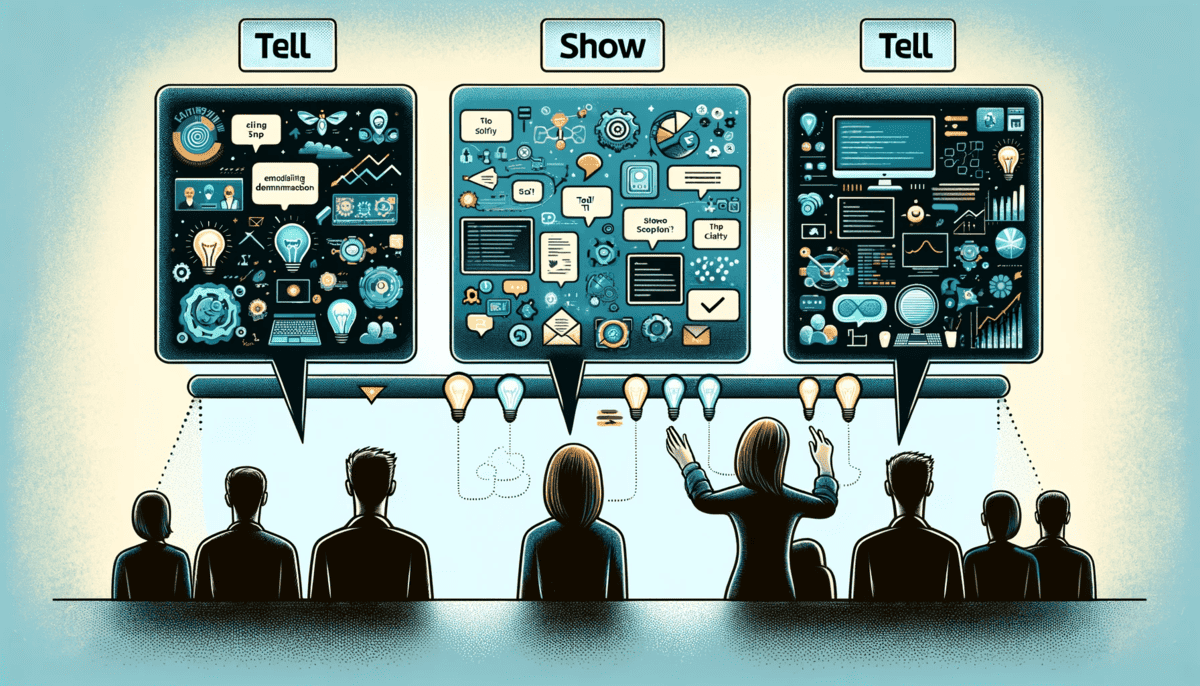
High performers strategically place their interactions throughout the demo while maintaining control and flow. Take Tell-Show-Tell, for example: the opening Tell sets context, the Show proves it, and the closing Tell lands the impact. The two Tells are where interaction belongs. The Show usually doesn't have much, because you've already said what they're about to see and why they care. Then you open the closing Tell into a real conversation: how would this change things for your team, and what would that mean for yours? The presenters who are exceptional at this are orchestrating conversation between stakeholders, not just between themselves and the room.

Taunya's diagnostic for a presenter who has lost the room and doesn't know it yet is almost embarrassingly simple. Look up. "If you have lost the room and you keep going, then you're basically a live recording."

Then she went after the habit most of us don't even hear ourselves doing. "Does that make sense?" She said, this is how a CTO receives it: of course it makes sense, what do you think, I'm an idiot? Chad has been working the phrase out of his own vocabulary and swapping in versions that put the burden back where it belongs.

  • Am I communicating that clearly?
  • Is that resonating?
  • Have I related it to your world?

A check-in isn't asking whether the buyer can follow a complex idea; it's asking whether you've said it in a way that fits their context, and it should genuinely open the door to being corrected.

He also shared an ancient, lowest-tech tip he borrowed from a former colleague: a sticky note with the name of every person in the meeting, and a check mark each time you interact with one of them. At a glance, you know that you haven't heard from Jodi in a while. That's what the 2% Factor looks like in practice. Not a technique overhaul, just small deliberate behaviors, repeated, that compound into a room that stays with you.

Jodi's tell comes from eleven years of casting, where people arrive wanting to be liked and perform the right answers. The ones who do well forget they're being evaluated and just engage. She listens for the moment a buyer shifts from "uh-huh, okay" to "wow, that would look like this for my team." That's the moment you stop teaching and start collaborating.

Taunya's virtual version of the same read is one question: are their cameras on?

The mental load underneath all three

Toward the end of the conversation, Chad connected all three trends to one root cause, and it reframes the whole session.

"I've got 100% of my mental energy that I can give to any task. I can't give more than that." When 80% of that energy goes toward remembering your own structure, or navigating an environment that breaks, the audience feels it, and what's left for reading the room is almost nothing.

Consider an SE two weeks into a new territory with a product release she has demoed exactly once. She's capable, and she prepared, but most of her attention is spent on where to click next, which means the VP who went quiet at minute twelve goes unnoticed until the debrief.

This is the argument for structure, and Taunya put it in the most usable terms of the day. Tell-Show-Tell asks three things of you: tell them why they should care about this topic, prove it works for them, then tell them what's in it for them. "It increases your confidence level by decreasing the barrier to entry. Get the structure down to 20% of your attention, and the other 80% goes to the room."

Jodi added that the audience has no idea what you decided to leave out. They don't know you planned to say eighteen thousand things and only got to seventeen thousand.

Taunya's follow-up got a laugh and is also just true: a good summary will make it feel like you covered all of it anyway.

What you should do this week

We closed with a lightning round. One thing, doable inside a week.

Taunya picked intention. Not an agenda, not a topic list. An intention. "My intention today in this meeting is to motivate, excite, inform. Whatever your intention is, all of your topics and all of your conversation should follow that true north."

Chad opened with a question. You've been to a party where one person wants to talk about everything they've ever done, and you've watched the room drift away from them, so why do so many sellers do that to buyers? His prescription: build a point of view about how to make the demo about your buyer, and if you aren't sure how, use your AI assistant to help you frame one before the call.

Jodi landed on presence. Focus on what the client needs, and while you're doing it, actually be with them rather than executing what you know.

An opening that earns the room in 90 seconds, three to five topics chosen by what the audience must know, and enough attention left over to notice whether they're still with you.

Watch The Anatomy of a Winning Demo

Transforming a Good Demo into a Great Demo

1 min read

Transforming a Good Demo into a Great Demo

Transforming a good demo into a great demo is key to driving your deals forward. Here are 9 tips to transform your demos.

Read More
Tell-Show-Tell: The Most Powerful Demo Technique

1 min read

Tell-Show-Tell: The Most Powerful Demo Technique

Tell-Show-Tell is one of the most powerful techniques a presenter can use in a software demo. This post is a conversation about Tell-Show-Tell...

Read More
The Streisand Effect and Broken Demos

1 min read

The Streisand Effect and Broken Demos

The Streisand Effect is why you should stop telling the audience that your demo is broken, because all you’re doing is drawing more attention to the...

Read More