Skip to the main content.
Book a Meeting Online Learning

6 min read

The Executive Pivot Framework: What to Do When the Meeting Changes

The Executive Pivot Framework: What to Do When the Meeting Changes

Nine minutes into a 30-minute meeting, the CIO pushes back from the table. "Let me stop you there," she says. "What I really need to know is whether this works with the platform we bought last spring." The Senior SE across from her rehearsed his deck twice. The answer she wants is on slide 14, and he's on slide 4.

He jumps ahead, then back, then ahead again. The meeting ends on time and on a friendly note: "Let's have the team follow up." By the time he reaches the elevator, he's replaying all of it. Did he miss something in his prep? Should he have seen it coming?

Odds are his prep was fine. Even the most reliable executives can change their tune in an instant, moving from Expressive to Analytical or from Amiable to Driver, and a squeezed schedule or a new priority can redirect them just as fast. It all comes down to the pressure in the room. If you're not ready for the shift, it can throw off the whole conversation, because the meeting gets decided by how you respond the moment it changes.

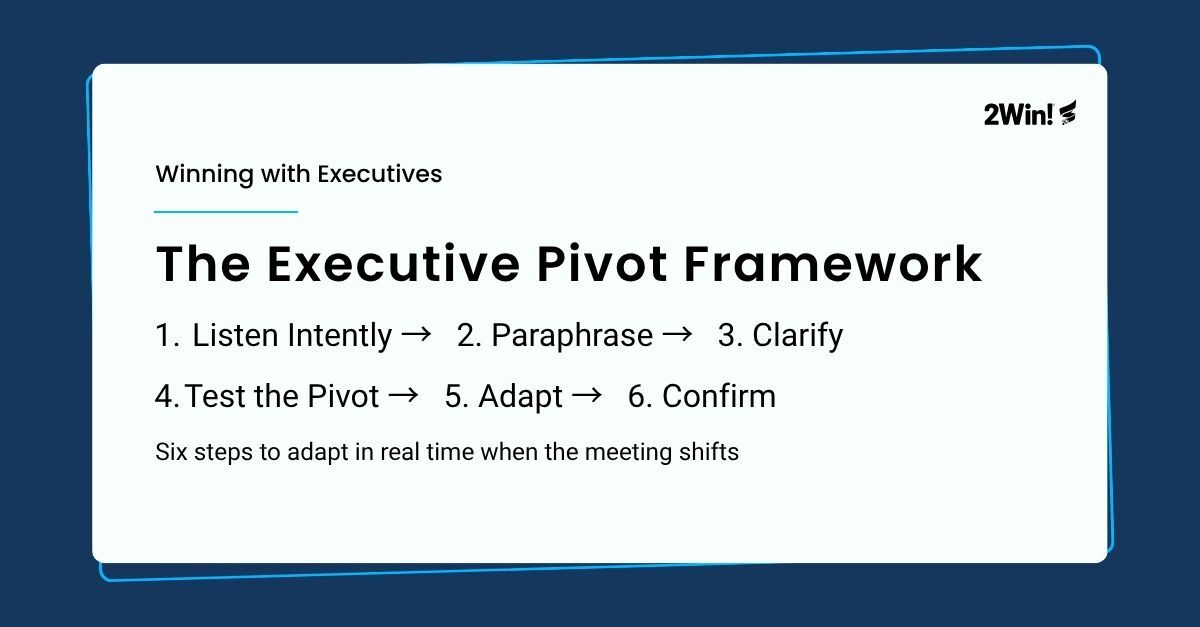
The Pivot Framework is a six-step method for handling mid-meeting shifts in executive conversations: Listen Intently, Paraphrase, Clarify, Test the Pivot, Adapt, Confirm. It gives sellers a repeatable way to listen for understanding and respond with purpose when an executive changes the meeting duration, their mode, or the topic, without losing the meeting's intended outcome.

Six steps that replace the Pause when an executive changes the meeting

The Pivot Framework comes from Winning with Executives. Its six steps run in the same order no matter what changed:

  1. Listen Intently. Catch the signal, which often lives in the tone or the interruption more than in the words.
  2. Paraphrase. Say back what you heard in one sentence, so the executive can confirm it or correct it.
  3. Clarify. Ask one question that pins down what changed and what matters to them now.
  4. Test the Pivot. Offer a new direction and check it with them before you commit.
  5. Adapt. Change the content to fit, which usually means cutting some of it or changing the order.
  6. Confirm. Check that the outcome you came for is still on the table, and ask for it.

Why the script takes over under pressure

When a meeting shifts, sellers reach for whatever they practiced. For many, that's material, like the deck and the talking points. Rehearsed content works fine until it stops fitting the room. After that, the only thing left to fall back on is more of the same content, delivered faster.

Winning with Executives starts prep in a different place. First, you decide where the meeting has to end. That outcome is your true north. When an executive moves the conversation, your job is to find a path from where they just took it to where it needs to finish. The six steps are how you find that path, but they only work if you know where you're headed.

Being agile is the difference between keeping your influence and losing control.

The three ways executive meetings shift

Almost every shift you'll face falls into one of three types. The same six steps handle all of them.

  • The time shift. The clock gets cut, and your 30 minutes turn into 10.
  • The mode shift. The executive's style changes mid-answer, often from wanting data (Analytical) to wanting the bottom line (Driver).
  • The topical shift. The executive takes the conversation somewhere you didn't plan.

The time shift: how to rebuild a 30-minute meeting in 10

The VP of Finance at a mid-size manufacturer sits down with an Account Executive and her SE in the last week of the quarter. Before the AE gets through her opening, he says, "This quarter's reports are a mess. I've got ten of our thirty minutes."

The instinct here is easy to picture. Without a method, the seller apologizes, talks faster, and tries to squeeze thirty minutes of material into ten. The VP gets a blur of slides and remembers none of them.

Running the six steps when the clock gets cut

  • Listen and Paraphrase, in the first ten seconds. "Understood. Ten minutes, and you need them to count." That tells him she heard the pressure behind the number.
  • Clarify and Test. "We planned to cover three things. With the time frame we have, would it help most to focus on cutting your month-end reconciliation time?" One question, one proposed focus, and he gets to pick.
  • Adapt. The company overview goes away. So do the product tour and two of the three topics. What's left is one point and the number that proves it.
  • Confirm. With two minutes left, she checks the outcome and asks for it: "If this matters, can we get thirty minutes with your controller next week?"

One priority made it through the cut, and the meeting still ended on a specific ask instead of trailing off.

A ten-minute meeting that ends with a clear next step beats a thirty-minute one that ends with "let's stay in touch."

The mode shift: giving the bottom line when an Analytical executive turns Driver

A CISO at a regional bank asks the SE how the product's detection accuracy was measured. That's an Analytical question, so the SE starts walking through the method: the test set and the false-positive rate. Three sentences in, the CISO cuts in. "Okay. Bottom line. Does my team spend fewer hours chasing alerts or not?

The trap is that the CISO asked for data just a minute ago. If the SE keeps answering that question, he ends up adding charts for someone who's already checked out.

Catching the flip and changing the delivery

Listening comes first. The interruption is the signal, and so are the shorter sentences and the words "bottom line." The CISO has moved from Analytical to Driver, and the SE's next sentence has to show he noticed.

So the SE paraphrases and clarifies in one breath: "So the real question is hours back for your team. Do you mean per person, or across the whole team?" The CISO says across the team, which tells the SE which number to lead with.

Then the SE tests a shorter answer and adapts on the spot: "Short version: about a third fewer alerts ever reach a person. Want the detail behind that, or should we keep moving?" The CISO wants to keep moving, so the SE goes straight to Confirm: "Is that number worth testing against your own alert data in a pilot?"

That's executive mode adaptation in practice. The point about accuracy never changed. It arrived as the answer to the question the CISO cared about, in the mode he was in by then.

The topical shift: answering "why yours instead?" without dropping your ask

The VP of IT at a regional insurer has been nodding along for fifteen minutes. Then she leans back. "I get that this is a priority. But we're in the middle of moving our claims system, and that's higher on my list. Why should I do yours instead?"

This is the shift that costs many deals, and it rarely involves a competitor. What you're up against is a higher priority, or the comfort of waiting.

Treating the question as useful information

  • Listen and Paraphrase. She just told you how she ranks her priorities. Say it back: "Fair question. So the claims move comes first this year."
  • Clarify. "What would the claims move need for you to call it a success?"
  • Test and Adapt. If her answer touches what you sell, connect the two honestly: "A lot of migration pain lands on your service desk. That's the part we'd take off your team." If it doesn't, say so and talk about when it would make sense.
  • Confirm. Watch for "That makes sense" or "I get it" here. Executives say both all the time, and all they confirm is that you were clear. Ask one more question to find out whether your point connects to what she cares about: "Does that make this a start-now project, or one for after the migration?"
"That makes sense" means the executive understood you. It doesn't mean they think it's a priority.

Compare those steps with the two moves that come naturally under pressure. Dodging the question and going back to the agenda leaves her objection sitting on the table. Chasing it with no destination in mind answers the objection, but the meeting runs out before the planned ask ever gets made.

Run the steps instead, and her criteria for this decision come out in the open, while the meeting still ends on your ask, even if the ask has become a start date after the migration.

How to prepare for a pivot: decide where the meeting has to end

None of this means walking in with three extra scripts. The framework is there so you can adapt in the room, and it's fine when the meeting doesn't go as planned. Good prep makes those in-room choices easier.

Picture an SE the night before a meeting with a CFO. Her agenda is done. She spends ten more minutes writing four lines:

  1. The outcome. What has to be true when the meeting ends? Maybe a pilot, or a second meeting with a named person.
  2. If the clock gets cut. The one priority that stays.
  3. If the mode flips. The bottom line, in one sentence.
  4. If the priority gets challenged. Her honest answer to "why this, why now," even if that answer is "next quarter."

That takes minutes, and it fits inside the prep she was already doing. Those four lines give her a destination, so when the CFO changes the meeting, she can find another way there.

What to do before your next executive meeting

Many sellers walk into executive meetings hoping they go the way they planned. The ones who win those meetings walk in expecting the meeting to move and knowing where it needs to end. Before your next one, write down the outcome first. Then sketch how you'd still reach it if the clock, the mode, or the priority shifts. You'll still have to adapt in the room, but you'll know which way to go.


You May Also Like

The Rules of Executive Selling Have Changed. Here's What Wins

The Rules of Executive Selling Have Changed. Here's What Wins

Executive selling has evolved. Learn why traditional preparation fails in high-stakes conversations and what enterprise sales teams must change to...
Read More
AI Won't Close Your Exec Deals: But It Can Help You Prepare Like You've Already Won

AI Won't Close Your Exec Deals: But It Can Help You Prepare Like You've Already Won

AI for executive engagement is changing how top teams prepare. Discover how AI-generated business cases and ROI models accelerate executive...

Read More
Driving vs. Reacting: Execs Don't Want More Info, They Want Faster Results

Driving vs. Reacting: Execs Don't Want More Info, They Want Faster Results

Executives prioritize speed and results over information. Learn how to anticipate needs and drive meetings rather than just reacting to them.

Read More