1 min read
Top Discovery Tips of 2025: Why There's No Excuse for Poor Discovery Anymore
The principles of discovery haven’t changed. But everything around it has.
5 min read
2Win!
Updated on September 5, 2026
Open a discovery call now and you find forty accurate minutes waiting for you. Every stakeholder quote, every number, every objection, timestamped and searchable. It looks like preparation, and it isn't, and the reason has nothing to do with the quality of the transcript.
A few years ago, a thin handoff announced itself. The AE ran discovery, formed a real read on the room, and then had no fast way to get that read out of their own head and into the SE's hands before Thursday's demo. What survived the trip was usually a Slack message squeezed between five other live deals, and the SE walked into the demo with vague questions and generic framing. Everyone in the room could feel it. That was uncomfortable, but it had one useful property: when preparation was missing, the absence was visible, and visible problems get fixed.
AI notetakers erased the tell without touching the cause. The handoff is exactly as broken as it was before. It just doesn't announce itself anymore, because the SE now walks in holding facts, and facts are not a strategy.
The buyer's side of that equation changed too. Being right about what a buyer said used to cost effort, and effort was scarce enough to signal something about how seriously a team was taking the deal. Now it costs a subscription. Once recall is free everywhere, it stops telling the buyer anything about how ready the team in front of them is, and it stops earning the benefit of the doubt that used to come with it. Trust has to come from somewhere else.
Sit through a real discovery call, and you're not neutral about what you heard. You noticed which stakeholder went quiet when budget came up, which one kept steering back toward a competitor's name, and which one is going to decide this deal regardless of what their title says. That read is a point of view, formed in real time out of dynamics that never made it into words and therefore never made it into the file.
You've never lacked that opinion, even carrying six or eight deals at once. What you've lacked is a reliable channel, and the transcript became the default one simply because it was there.
The problem is that a point of view is precisely the thing a transcript cannot carry. Flatness is what makes a transcript accurate, and flatness means every voice in the room gets recorded at the same weight. A summary will give the VP of Operations and the analyst who spoke twice identical treatment, because ranking is not a function a summary performs. It transcribes.
Nobody has ever read a call summary and concluded that the VP of Operations was the real risk in the deal, and why.
Your SE doesn't have room to perform that function either, and this is where the economics stop being abstract. Vivun's State of Sales Engineering report describes a 4:1 AE-to-SE ratio taking hold as the working benchmark, which means the person you're handing this to is splitting their week across your deal and at least three others. In a separate Vivun survey of 200 B2B account executives, 64% said they had a deal lost or significantly delayed in the previous six months while waiting on technical selling resources, and a quarter said it had happened more than once. At that coverage, an SE is triaging between calls, not sitting with forty minutes of audio long enough to reconstruct your read on a stakeholder they've never met.
Send the recording instead of the judgment and you haven't saved anyone time. You've handed over the one task they have the least capacity in their week to do, and the deal absorbs the cost when they can't get to it.
Worth saying plainly: the fix the presales community already built doesn't close this gap. Requiring discovery notes on file before an SE gets staffed to a demo is a real forcing function, and it caught plenty of cases where an SE was walking in blind. But a gate verifies that a field contains content, not that a decision was made, and a transcript pasted into the required box clears it cleanly. You end up with a compliant pipeline full of documents nobody formed a position in.
That's the distinction worth holding onto as the tooling keeps improving. Better capture narrows the recall gap. It widens the judgment gap, because a model can rank what was said by prominence, and it cannot hold a position on a deal it has no stake in winning.
This is where stakeholder mapping earns its place, and it's worth being precise about what it is. It sorts the room by what each person actually cares about, whether that's the daily work in front of them, the number their department is measured against, or the direction the whole organization is trying to move. Operational, departmental, strategic. Three levels, and the labels matter far less than the discipline the sorting demands.
The discipline is this: you cannot finish the map without committing to an answer.
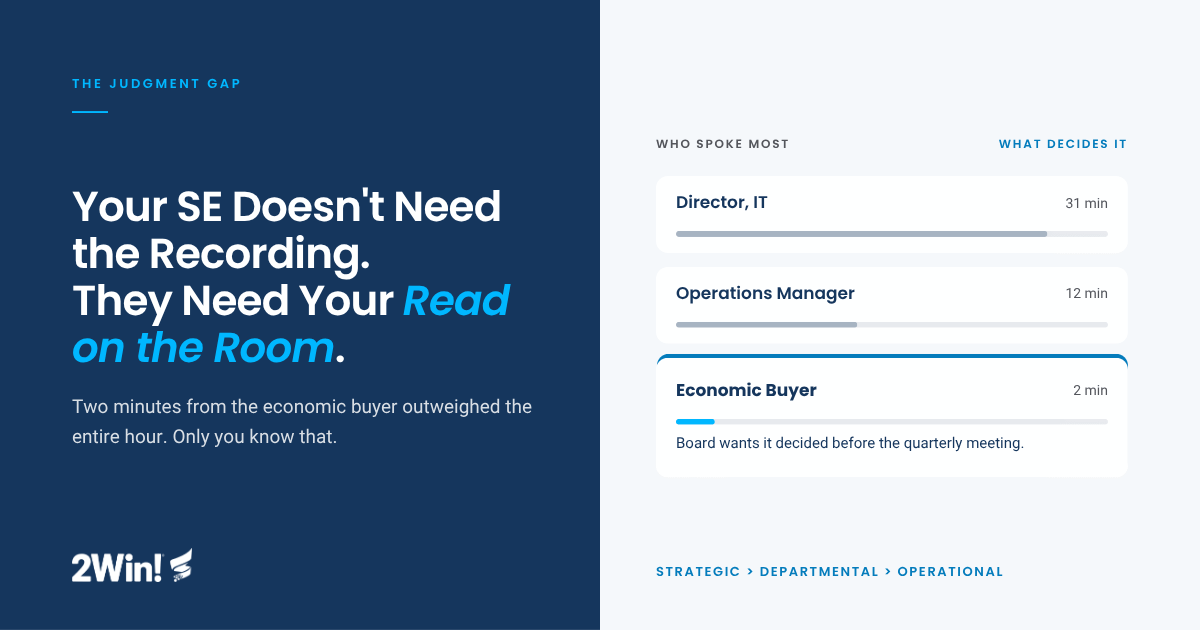
Take the deal from the opening. Sorted by airtime, the director who spent half the call on integration specs wins easily. Sorted by what the deal turns on, two sentences from the economic buyer about a board deadline she didn't dwell on outrank thirty-eight minutes of integration questions, because everything else in the deal is downstream of that date. Making that call is a stated position: this deal turns on the deadline, not the specs. No summary is going to generate that for you. The transcript supplies the facts the map is built from, and you supply the intelligence, and you're the one who does the placing.
Hand that map to your SE alongside the recording and their limited hours go into building the demo around the level the deal turns on, instead of first having to decide alone whose questions counted. The recording still gets read, but by someone holding a business case rather than forty minutes of undifferentiated audio. That's what AE and SE alignment was always supposed to look like: not two people staring at the same file, but one person's judgment reaching the other in time to use it.
Here's where most teams stop, and where the argument gets interesting.
If you write the map, send it over, and then take your usual seat off to the side while your SE presents, you've handed over the intelligence and withheld the execution. The buyer never experiences your map. They experience two people either working from it or not.
That's the part worth sitting with, because the demo is the moment the buyer decides whether any of this is real, and it's a team performance whether or not the team rehearsed it. The director needs to hear operational proof that the integration works the way he needs it to. The economic buyer needs to hear the demo connected to her deadline and the outcome behind it. Some of those moments belong to the SE and some of them belong to you, and knowing which is which in advance is the entire difference between contributing and interrupting.
There's a second-order effect here that most teams underestimate. A buyer watching an AE and SE work from the same understanding, handing off cleanly and reinforcing each other at the right level, draws a conclusion that has nothing to do with the product: this is what working with these people will feel like after the contract is signed. Coordination in the pre-sale room is the most credible preview of the post-sale experience a team can offer, and it cannot be faked with recall.
Nothing here argues against the tools. Keep the recording running, because the facts it captures are the raw material everything else is built from. Just don't let it stand in for the one thing it structurally cannot do.
Before your next significant demo, add the piece it can't produce. Write one sentence naming which level the deal turns on and why, and send it alongside the transcript rather than in place of it. At full strength, that sentence becomes the opening line of a Win Plan, where the team aligns on strategy, messaging, and who owns which moment before anyone opens the platform. But you don't need the whole apparatus to start. You need the sentence on the next deal on your calendar.
The buyer three vendors deep is going to keep hearing perfect recall from every team that follows you. When memory is identical everywhere, a point of view is the only variable left, and it's the one she's using to choose.
1 min read
The principles of discovery haven’t changed. But everything around it has.
1 min read
Two sales teams. Same product. Same quarter. Radically different results.
1 min read
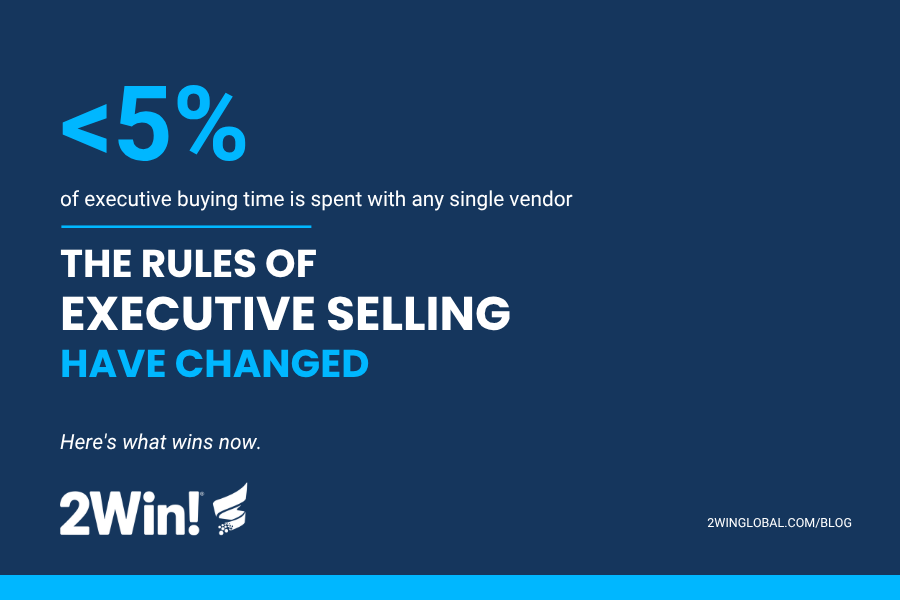
Executives spend less than 5% of their buying time with any single vendor, and that number isn't trending upward.