.svg "2Win logo25 white (1)")


 2Win!
2Win!
Meet Our Newest Team Member: Wyn
As we continue to innovate in the sales training industry, we're excited to introduce our newest team member: Wyn.
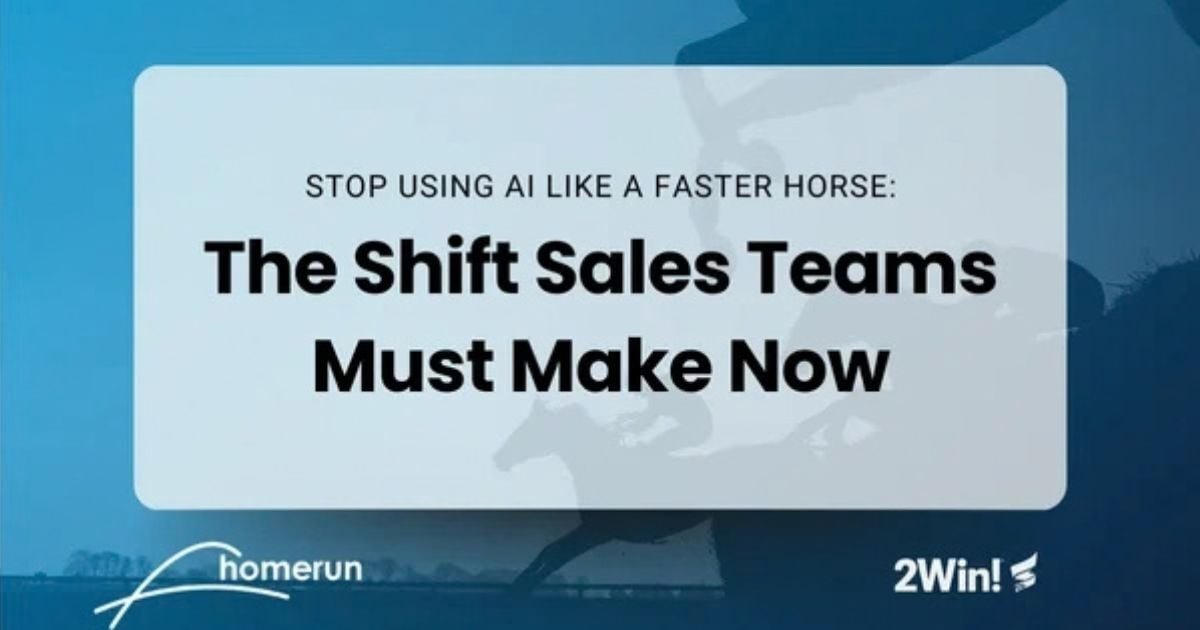
AI is everywhere in sales right now—and most teams are using it the exact same way.
They’re summarizing calls. They’re polishing emails. They’re speeding up the admin work that slows them down. And to be clear: those efficiency gains matter. Every rep could use more minutes back in their day.
But here’s the disconnect we’re seeing across the industry:
AI is reshaping how we work, but it’s not reshaping sales performance.
When we look at the data, it makes perfect sense why.
Mastering Both Sides of the AI Equation: Ebook
According to recent survey findings from HomeRun—one of the most active and insightful presales networks today—the overwhelming majority of sellers are using AI for tasks that make them faster, not better.
Here’s the pattern the data shows:
Summarizing calls
Writing nicer emails
General productivity shortcut
Great for convenience. Helpful for pace. But none of this materially changes how a rep performs in the key moments that drive revenue.
Efficiency solves for time. Effectiveness solves for outcomes. And right now, most teams are investing almost exclusively in the former.
That’s why so many organizations report that AI feels “busy,” but not “transformative.” We’ve optimized the surface-level tasks—but not the interactions that determine whether a deal moves forward or stalls out.
Because here’s the truth: Optimizing email writing doesn’t improve discovery. Summaries don’t elevate demo execution. No productivity hack increases buyer confidence.
Sales is a system of interconnected moments. AI used only at the task level improves none of them.
What’s happening in sales right now looks a lot like New York City in the early days of cars. Early adopters didn’t build highways. They didn’t rethink road systems. They didn’t imagine new rules of the road.
They just tried to use cars… exactly like faster horses.
The technology was new. The behavior stayed the same.
And progress stalled until cities redesigned the system around what the new technology made possible.
That’s exactly where most sales teams are today.
Giving reps access to ChatGPT isn’t AI adoption. It’s AI availability.
Organizational-wide AI adoption looks very different:
Redesigning sales processes using business process re-engineering, not guesswork
Building AI-powered workflows around critical buyer interactions
Ensuring every rep executes moments—like discovery, demos, value storytelling—with consistency
Integrating AI into the operating system of the organization, not just the rep’s daily shortcuts
Individual usage = faster tasks.
Organizational usage = better performance.
And systems thinking is how the best teams will win.
Because when AI reshapes how your reps execute discovery, communicate value, build business cases, or Stop Using AI Like a Faster Horse: The Shift Sales Teams Must Make Now, you’re no longer getting 5–10% efficiency gains.
You’re getting performance gains your competitors cannot easily copy.
Picture two sales reps walking into similar opportunities with similar prospects. Both have access to the same AI tools. Both are using ChatGPT to draft emails, summarize call notes, and automate their admin work. On paper, they're equals.
Fast forward six weeks. The first rep closes the deal at full value with enthusiastic buy-in from all stakeholders. The second rep is stuck in a procurement loop, facing price objections and losing momentum. What happened?
The difference wasn't in the tools they used—it was in where they applied them.
Everyone has access to the same AI tools. But not everyone will use them to change how they sell.
Your competitors are also summarizing calls. They're also writing emails faster. They're also automating admin work. That's the baseline—table stakes in 2025.
The competitive edge comes from teams who use AI to elevate the moments that matter most:
Discovery conversations: using AI to uncover deeper insights and ask better questions
Demo storytelling: Crafting narratives that resonate at every level of the Value Pyramid
Executive alignment: Translating technical features into strategic business outcomes
Business case development: Building compelling ROI stories backed by data
Final decision-team interactions: Anticipating objections and addressing them proactively
These moments, not your inbox, are where deals are won or lost.
Think back to that first sales rep. She didn't just use AI to work faster, she used it to prepare for a discovery call that uncovered a strategic initiative the prospect hadn't even mentioned in the RFP. She used it to craft a demo narrative that had her champion saying, "This is exactly what we need." She used it to build an executive briefing that made the CFO lean forward in her chair.
Right now, most organizations are still in the "faster horses" phase; using AI to do the same things they've always done, just with less effort.
So here’s the real question:
Are you using AI to work faster—or to work fundamentally better?
Because if your AI strategy stops at summaries and email polish, you’re optimizing for yesterday’s game.
The teams that win in the next era of sales will:
Move from individual shortcuts to organizational systems
Apply business process re-engineering to their sales methodology
Use AI to execute more effectively in the interactions that determine revenue, not just productivity
AI doesn’t create competitive advantage.
How you rebuild your sales system around AI does.
And that work starts now.
→ Secure your advantage. Book time with us or reserve seats in an upcoming Demo2Win workshop.

As we continue to innovate in the sales training industry, we're excited to introduce our newest team member: Wyn.
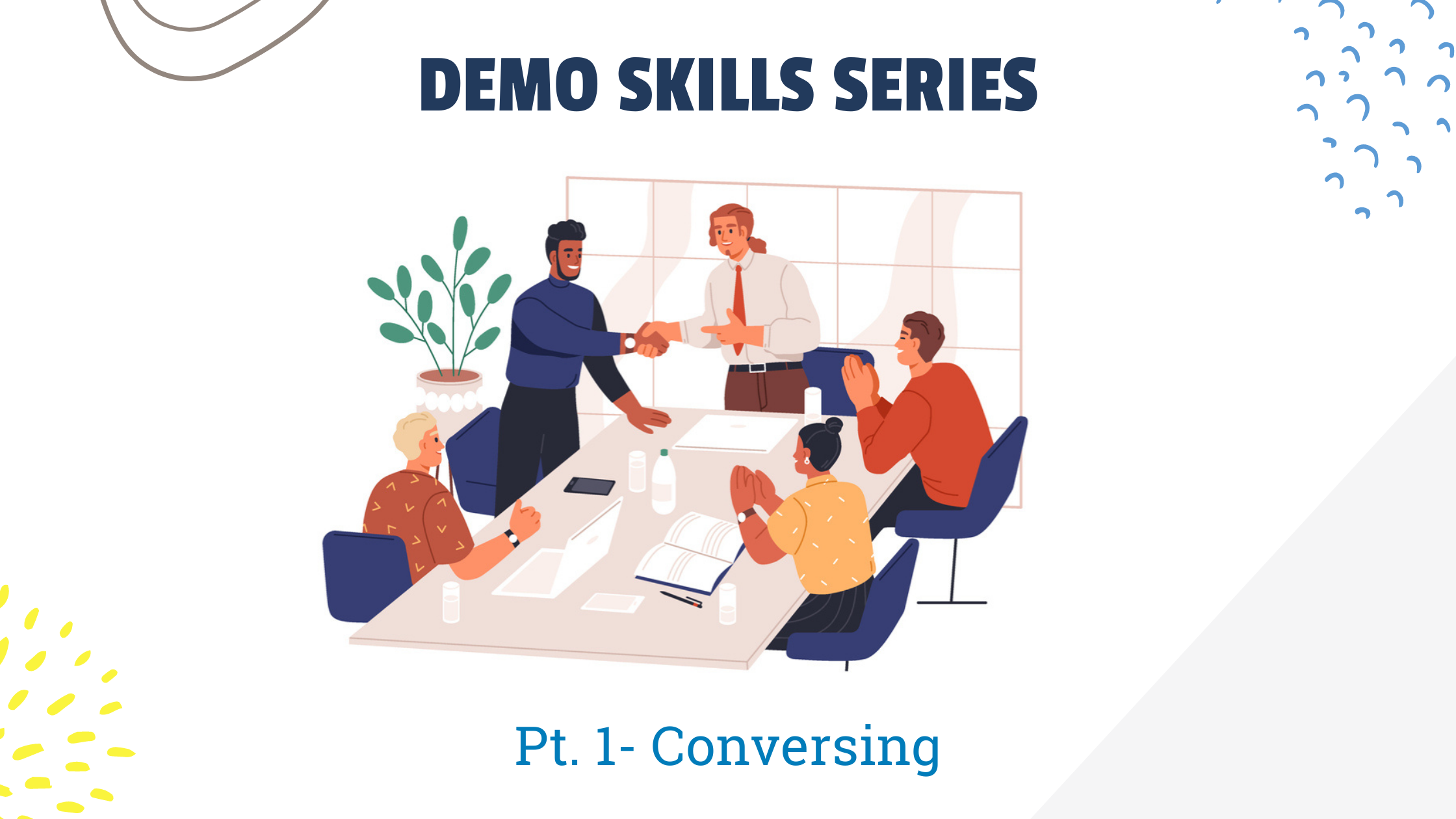
Demoing to large groups can be daunting but it doesn't have to be. Learn how to section your demo to fit the needs of every member of the audience.

Small, consistent demo improvements lead to significant gains. Learn how micro-improvements and a structured framework can enhance your sales and...